Table of Contents
Buffalo Rebbe Eliyahu Yosef Rabinowitz
ציון ואוהל רבי אליהו יוסף ב״ר גדליה אהרן רבינוביץ זצ״ל
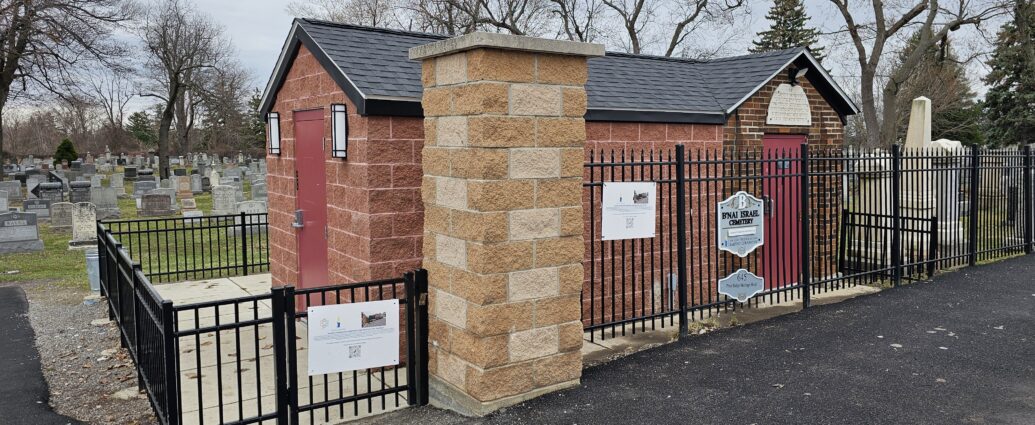
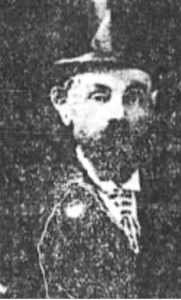
The Buffalo Rebbe Tzion, also known as the Buffalo Ohel or Buffalo Kever, is the resting place of Rebbe Eliyahu Yosef Rabinowitz (c. 1856–1910), a descendant of the Linitz–Sokolivka Chassidic dynasty and one of the earliest Chassidic Rebbes to establish himself permanently in the United States. He is widely regarded as the first Chassidic Rebbe buried in America.1
ציון האדמו״ר מבאפלו, הידוע גם בשם אוהל באפלו או קבר האדמו״ר מבאפלו, הוא מקום מנוחתו של הרה״ק רבי אליהו יוסף ב״ר גדליה אהרן רבינוביץ זצ״ל (בערך תרט״ז–תרע״א), מצאצאי שושלת ליניץ–סוקוליבקה ומראשוני האדמו״רים החסידיים שקבעו את מושבם בארצות הברית. הוא נחשב לאדמו״ר החסידי הראשון שנקבר בארצות הברית.
Buffalo Rebbe Tzion Location
📍 Address:
645 Pine Ridge Heritage Blvd
Cheektowaga, NY 14225, United States
The Buffalo Rebbe Tzion is located along Pine Ridge Road at Maryvale Drive, at the entrance area of Buffalo’s historic Pine Ridge Jewish cemetery complex.
Visitor Information
The Tzion is open 24 hours a day, year-round, and includes an indoor space for visitors. Located directly along the street, it is easily accessible at any time. Free street parking is available immediately beside the Tzion, with virtually no walk required from your vehicle. The entry code is discreetly posted on the door in Alef-Beis (Hebrew letters).
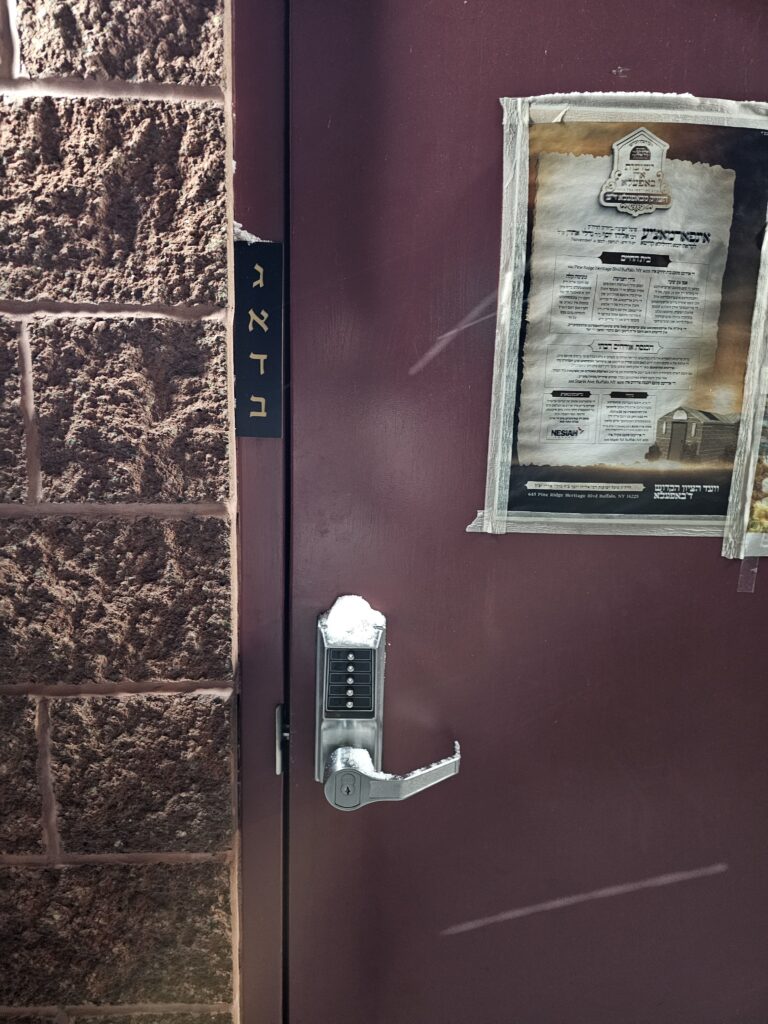
Candles, matches, siddurim, Tehillim, paper, and pens are available on site. Visitors may write a kvitl (personal prayer note), light a candle in memory of the Tzaddik, daven, and spend time in prayer and reflection at his Kever. There are no restroom facilities at the Tzion.
The Buffalo Rebbe Tzion (ציון באפאלו) is located at the corner of Pine Ridge Road and Maryvale Drive, within the entrance area of B’nai Israel Cemetery, part of the historic Pine Ridge Heritage complex. This sacred site, also known as the Buffalo Ohel (אוהל באפאלו), is the Kever of the Tzaddik, Rebbe Eliyahu Yosef Rabinowitz, the first Chassidic Rebbe buried in the United States.
מידע למבקרים
הציון פתוח 24 שעות ביממה, בכל ימות השנה, וכולל מקום פנימי למבקרים. הציון ממוקם ממש לצד הרחוב, והגישה אליו נוחה בכל שעה. חניה חינם ברחוב זמינה מיד בסמוך לציון, וכמעט שאין צורך ללכת מהרכב. קוד הכניסה מופיע באופן דיסקרטי על הדלת באותיות אלף בית.
נרות, גפרורים, סידורים, ספרי תהילים, נייר וכלי כתיבה זמינים במקום. המבקרים יכולים לכתוב קוויטל (פתק בקשה ותפילה), להדליק נר לזכר הצדיק, להתפלל ולשהות במקום לתפילה ולהתבוננות ליד קברו. אין במקום שירותים.
אינפארמאציע פאר באזוכער
דער ציון איז אפן 24 שעה א טאג, א גאנץ יאר, און עס איז דא אן אינעווייניקסטער פלאץ פאר באזוכער. דער ציון געפינט זיך גלייך ביים גאס, און מען קען גרינג צוקומען אין יעדע צייט. אומזיסטע גאס פארקינג איז פאראן גלייך נעבן ציון, און מען דארף כמעט נישט גיין פונעם אויטא. דער אריינגאנג קאָד איז דיסקרעט געשריבן אויפן טיר מיט אותיות פון אלף בית.
ליכט, שוועבעלעך, סידורים, תהילים, פאפיר און פעדערס זענען פאראן אויפן ארט. באזוכער קענען שרייבן א קוויטל, צינדן א ליכט לזכר דעם צדיק, דאווענען און פארברענגען צייט אין תפילה און התבוננות ביים קבר. עס זענען נישטא קיין בית הכסא איינריכטונגען אויפן ארט.
History of Rabbi Eliyahu Yosef Rabinowitz
Rebbe Eliyahu Yosef Rabinowitz was born around 1856 in Justingrad/Sokolivka, then part of the Russian Empire and today in Ukraine. He was the son of Rebbe Gedaliah Aharon Rabinowitz, the Linitz–Sokolivka Rebbe and author of Chen Aharon.2
He belonged to a distinguished Chassidic dynasty reaching back to the earliest generations of Chassidus. Among his ancestors was Rebbe Gedaliah of Linitz, author of Teshuos Chen, who was connected with several of the formative figures of the Chassidic movement, including Rebbe Yaakov Yosef of Polnoye, author of Toldos Yaakov Yosef, the Maggid of Mezritch, and the Baal Shem Tov.
The leadership of the dynasty continued through Rebbe Gedaliah of Linitz’s descendants. His son Rebbe Shmuel Yehudah Leib became Rebbe in Linitz, followed by his brother Rebbe Yitzchak Yoel. Rebbe Yitzchak Yoel’s son, Rebbe Gedaliah Aharon, later became associated with Sokolivka, where the Rabinowitz family became an important rabbinic and Chassidic presence.
Rebbe Eliyahu Yosef was also connected through marriage to another major Chassidic dynasty. His wife was a daughter of Rebbe Meshulam Zusha Auerbach, making him the brother-in-law of the renowned Rebbe Mordechai Dov Twersky of Hornosteipel. The two were also chavrusa, Torah study partners.
In 1899, Rebbe Eliyahu Yosef immigrated to the United States and settled first on New York City’s Lower East Side. By that time, Jews from Sokolivka and the surrounding region had begun establishing themselves in Buffalo. When former followers of the Rabinowitz family learned that the Rebbe was living in New York, they invited him to come to Buffalo.
He accepted their invitation and moved to Buffalo in 1908.
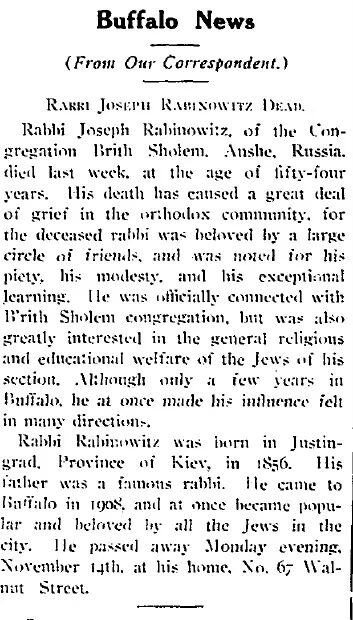
A contemporary Jewish newspaper identified him with the congregation “B’rith Sholem, Anshe Russia.” He also became closely associated with Buffalo’s growing Orthodox Jewish community, including immigrants from Sokolivka and other parts of the Russian Empire.
Although Rebbe Eliyahu Yosef lived in Buffalo for only about two years, contemporary records show that he made a remarkable impression on the city.
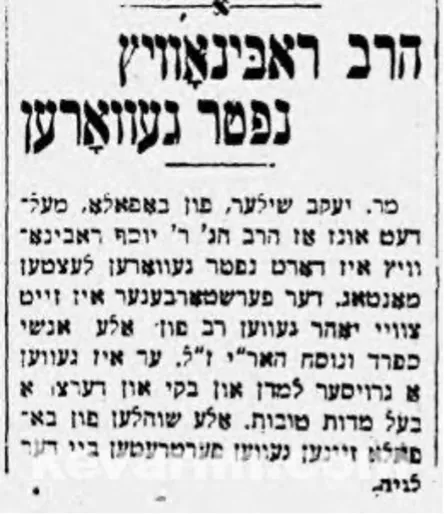
Shortly after his passing, The American Hebrew and Jewish Messenger described him as a man noted for his “piety, his modesty, and his exceptional learning.” The newspaper emphasized that his concern extended beyond his own congregation to the wider religious and educational welfare of Buffalo’s Jews, and wrote that despite his relatively short time in the city, he had already “made his influence felt in many directions.”
The account provides a rare contemporary picture of the Buffalo Rebbe—not only as the leader of a particular congregation or group of Chassidim, but as a respected Torah figure whose influence was felt throughout Buffalo’s Jewish community.
Rebbe Eliyahu Yosef lived at 67 Walnut Street in Buffalo. He passed away there on Monday evening, November 14, 1910, at approximately 54 years old.3
Because his passing occurred Monday evening after nightfall, the Jewish date was 13 Cheshvan 5671 — י״ג חשון תרע״א, which remains the date of his annual yahrzeit.
He was laid to rest in the Pine Ridge Jewish cemetery complex in Cheektowaga, where his Ohel stands today.
The Buffalo Rebbe Ohel
An Ohel is a structure erected over or around the resting place of a prominent Tzaddik or Torah leader. An Ohel was built over Rebbe Eliyahu Yosef’s Kever around 1920, approximately a decade after his passing.
For generations, Jews continued to visit the Buffalo Rebbe Tzion to daven and say Tehillim. Over time, the small brick building itself became a familiar landmark along Pine Ridge Road.
By the early twenty-first century, the aging structure required significant repairs. The Ohel undertook a major restoration project that included stabilizing the foundation, replacing the roof and flooring, enlarging the interior, and improving access for visitors, including accommodations for Kohanim. The restored Ohel was dedicated in 2022. 4
The Sokolivka Legacy
The history of the Buffalo Rebbe is closely connected with Buffalo’s large community of immigrants from Sokolivka.
Sokolivka, also known as Justingrad, was home to a substantial Jewish population and to the Rabinowitz rabbinic dynasty. Beginning in the late nineteenth and early twentieth centuries, many of its Jewish residents emigrated to the United States. Particularly large groups settled in Buffalo, New York City and Newark.
Over 200 families from Sokolivka eventually settled in Buffalo, creating one of the strongest immigrant connections between the town and an American Jewish community. The community was large enough to establish its own synagogue, Anshe Sokolovka, as well as the Ustingrader Unterstitzung Verein, a benevolent society for immigrants from the town.5
Rebbe Eliyahu Yosef’s brother, Rebbe Pinchas Rabinowitz, remained in Sokolivka and succeeded their father as its Rav and Chassidic leader. The Sokolivka memorial literature remembers him as a great Torah scholar and a humble, saintly leader with Chassidim throughout Sokolivka and the surrounding region.
During the terrible pogroms that swept Ukraine following the First World War, Rebbe Pinchas was murdered al kiddush Hashem on 7 Av 5679 (1919).
Buffalo’s Sokolivka immigrants preserved the memory of those who had been murdered in their hometown.
In 1964, members of Buffalo’s Sokolivka community erected a memorial in the nearby Holy Order of the Living Cemetery to the Jews of Sokolivka who were murdered in the 1919 pogroms. Among those specifically remembered on the monument is Rebbe Pinchas Rabinowitz.
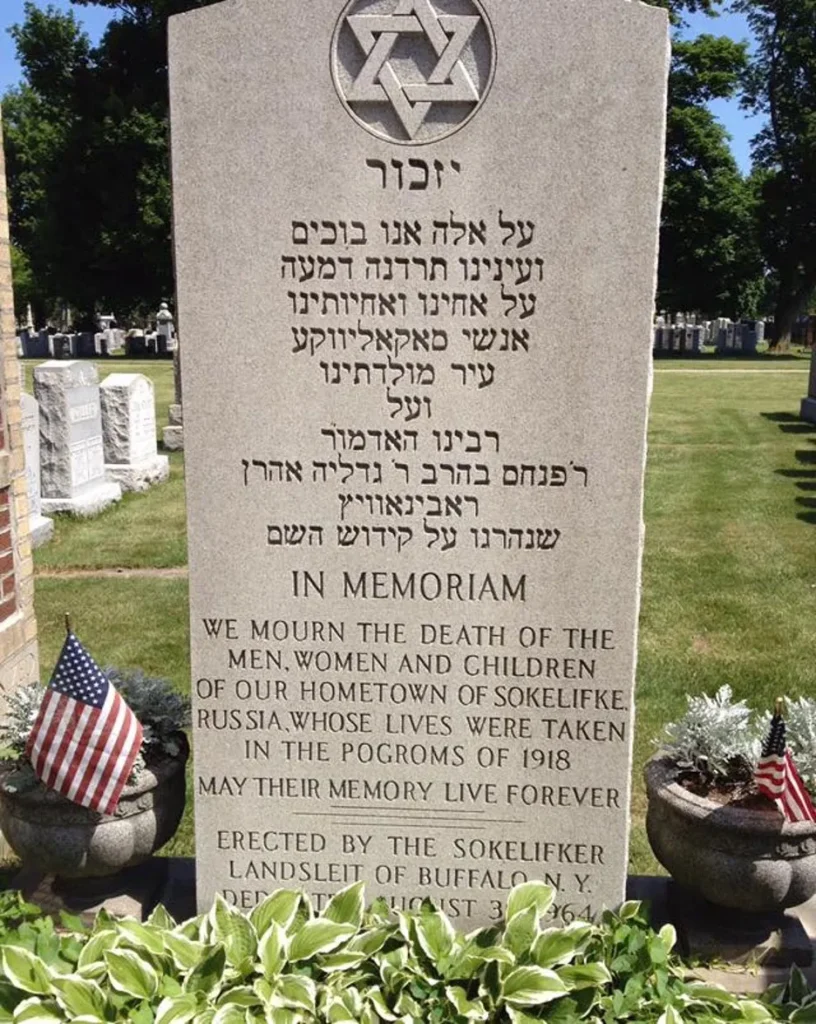
Its Hebrew inscription remembers:
“Our Rabbi, our Master, our Teacher, Reb Pinchas son of Rabbi Gedaliah Aharon Rabinowitz, martyred in the Sanctification of His Name.”6
The memorial stands only a short distance from the Buffalo Rebbe’s Ohel and preserves the memory of Rebbe Pinchas, his community, and the strong connection between Sokolivka and Jewish Buffalo.
The Buffalo Rebbe Tzion Today
For much of the twentieth century, knowledge of the Buffalo Rebbe’s Kever remained largely among Buffalo Jews, descendants of Sokolivka families, and those familiar with early American rabbinic history.
In the later twentieth century, Rabbi Yonah Landau, a noted researcher of early American rabbanim, synagogues and Jewish cemeteries, played an important role in bringing the Buffalo Rebbe’s resting place to wider attention. Rabbi Moshe Taub records that, following Rabbi Landau’s efforts and organized visits, tens of thousands of Jews from across the Torah world have made pilgrimages to the Ohel.[6]
Today, Jews visit the Buffalo Rebbe Tzion throughout the year from Buffalo, Toronto, New York and communities across North America, with additional visitors coming around the Rebbe’s yahrzeit on 13 Cheshvan.
Many visitors say Tehillim, give tzedakah, learn Torah and write a kvitl containing their Hebrew name and their mother’s Hebrew name. Others come simply to spend a few quiet moments in prayer at the resting place of one of America’s earliest Chassidic Rebbes.
More than a century after his passing, Rebbe Eliyahu Yosef Rabinowitz remains an important figure in the early history of Chassidus in America.
Today, the Buffalo Rebbe Tzion on Pine Ridge Road draws tens of thousands of visitors throughout the year for tefillah and Tehillim, and remains an important destination for Jews visiting Buffalo and Western New York.
Sources & Footnotes
- The Buffalo Rebbe as an Early Chassidic Rebbe in America
Rebbe Eliyahu Yosef Rabinowitz is widely identified as among the earliest Chassidic Rebbes to settle permanently in the United States and as the first Chassidic Rebbe buried in America.
Kevarim.com — Rebbe Eliyahu Yosef Rabinowitz
Mishpacha — “The Buffalo Rebbe”
American Jewish Year Book, Volume 13, 1911–1912
The American Jewish Year Book, Vol. 13 (5672 / 1911–1912), p. 136, lists Joseph Rabinowitz, rabbi of Buffalo, born approximately 1856 and deceased in Buffalo on November 14, 1910, aged 54. This contemporary national reference provides independent confirmation of his date and place of death.
Original volume:
American Jewish Year Book 5672 (1911–1912) — Wikimedia Commons, full public-domain scan
American Jewish Year Book, Volume 13 — Google Books ↩︎ - The Linitz–Sokolivka Dynasty and Family Sources
The Rabinowitz family’s Chassidic lineage is preserved in the dynasty’s own sefarim and family genealogical material.
Rebbe Gedaliah of Linitz was the author of Teshuos Chen. His descendant Rebbe Gedaliah Aharon Rabinowitz, father of Rebbe Eliyahu Yosef, was the author of Chen Aharon. The National Library of Israel catalogs Rebbe Gedaliah Aharon as being of Linitz and Sokolivka and identifies him as the son of Rebbe Yitzchak Yoel.
An important early family source is Rebbe Yehoshua Heshel Rabinowitz’s Toras Avos, published in New York in 1926, which includes genealogical material relating to the Linitz dynasty.
National Library of Israel — Chen Aharon, Rebbe Gedaliah Aharon Rabinowitz
National Library of Israel — Gedaliah Rabinowitz / Linitz Dynasty ↩︎ - Contemporary Buffalo Account — The American Hebrew and Jewish Messenger
“Rabbi Joseph Rabinowitz Dead,” The American Hebrew and Jewish Messenger, Buffalo Section, 1911.
The contemporary notice records Rabbi Rabinowitz’s birth in Justingrad around 1856, his arrival in Buffalo in 1908, his association with B’rith Sholem, Anshe Russia, and his residence at 67 Walnut Street.
It describes him as noted for his piety, modesty and exceptional learning, and records his interest in the broader religious and educational welfare of Buffalo’s Jewish community. It also records his passing on the evening of November 14, 1910.
Library of Congress — The Jewish Messenger / American Hebrew and Jewish Messenger
ProQuest — American Hebrew Historical Newspaper Collection ↩︎ - Immigration, Hornosteipel Connection and the Ohel
The Jewish Federation Cemetery Corporation records that Rebbe Eliyahu Yosef immigrated to the United States in 1899, settled first on New York City’s Lower East Side, and moved to Buffalo in 1908.
It also records his family relationship and Torah-study partnership with Rebbe Mordechai Dov Twersky of Hornosteipel, and dates the construction of the Ohel to approximately 1920.
The same source documents the more recent restoration and enlargement of the Buffalo Rebbe Ohel.
Buffalo Jewish Federation Cemetery Corporation — Ohel Project ↩︎ - Selig Adler and Thomas E. Connolly, From Ararat to Suburbia: The History of the Jewish Community of Buffalo(Philadelphia: Jewish Publication Society of America, 1960), p. 198.
Adler and Connolly discuss the large migration from Sokolivka to Buffalo and the establishment of Anshe Sokolovka and related communal institutions. ↩︎ - Sokolivka, Rebbe Pinchas Rabinowitz and the Buffalo Landsleit
The Sokolivka Memorial Book preserves the history of Sokolivka’s Jewish community, its Rabinowitz rabbinic dynasty, the pogroms and the large migration of Sokolivka Jews to Buffalo.
It identifies Rebbe Pinchas Rabinowitz as the son and successor of Rebbe Gedaliah Aharon, describes his Torah scholarship and spiritual leadership, and records his murder during the pogroms of 5679 (1919).
The memorial history also records the migration of as many as 200 Sokolivka families to Buffalo and documents the memorial erected by Buffalo’s Sokolivka community for those murdered in the pogroms.
JewishGen Yizkor Book — Sokolivka: “The Sokolievka Rabbi”
JewishGen Yizkor Book — Sokolivka Diaspora and Buffalo Memorial
Complete Sokolivka / Justingrad Memorial Book ↩︎