הרב אברהם מאיר ב״ר זאב וואלף פרנקלין זצ״ל — אב״ד באפלו
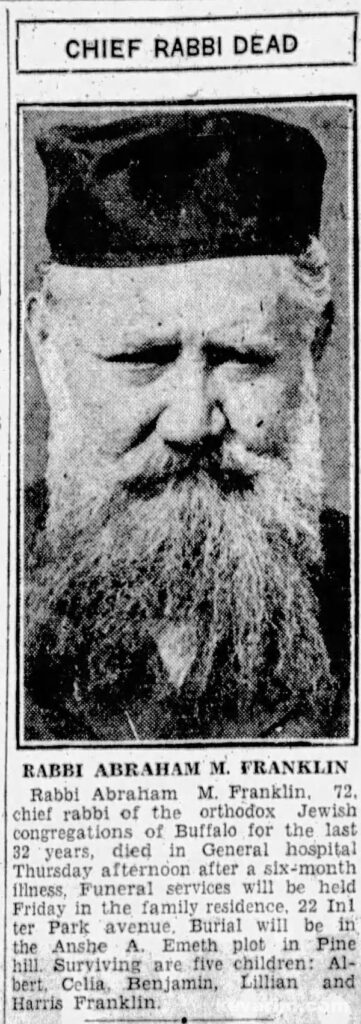
Chief Rabbi of Buffalo 1900-1932
Yahrzeit: 4 Cheshvan | יארצייט: ד׳ חשון
Kever Location: Anshe Emes Cemetery, 548 Pine Ridge Heritage Blvd, Cheektowaga, NY 14225.
Directions: The first kever on the left, immediately upon entering through the round cemetery gate – at the road.
https://maps.app.goo.gl/hy6k7PQBbcv2umh16
Table of Contents
Overview
Rabbi Avraham Meir Franklin (1862/63–1932 | תרכ״ג–תרצ״ג) was one of the most prominent Orthodox rabbinic leaders in Buffalo’s Jewish history, serving the city’s Jewish community for approximately 32 years, from 1900–1901 / תרס״א until his passing in 1932 / תרצ״ג. Born in Novy Dvor, in the Vilna region of the Russian Empire, and educated in the Lithuanian Torah tradition, he was appointed a rabbi in Buffalo in 1900–1901 / תרס״א, beginning more than three decades of religious and communal leadership.
Known as “רב הכולל דבאפאלא והסביבה” (Rav Hakollel of Buffalo and the surrounding area) and widely referred to as the “Chief Rabbi of Buffalo,” Rabbi Franklin held a leading position in the city’s Orthodox Jewish community. He was documented as Rav Hakollel by 1921 and continued serving Buffalo until his death in 1932.
Rabbi Franklin served as Rav of Congregation Anshe Emes, the historic “Little Hickory Shul.” His responsibilities encompassed kashrus, shechita, mikvaos, Jewish law, and communal affairs, helping preserve traditional Jewish observance during a period of rapid growth and change in American Jewish life.
Among the most fascinating aspects of his career was his involvement in the early history of kosher Coca-Cola, including kosher supervision of the beverage in Buffalo by 1930. This remarkable connection places Rabbi Franklin within an important early chapter of American kosher certification.
Rabbi Franklin’s scholarship, leadership, and decades of service established him as a significant figure in the development of Orthodox Jewish life in Buffalo, New York, and his legacy remains an important part of the city’s Jewish heritage.
Early Life and Arrival in Buffalo
Rabbi Franklin was born in 5623 (1862–63) in Novy Dvor, in the Vilna Governorate.
His early Torah education was under his maternal grandfather, Rabbi Gershon Wanger of Bialystok, a distinguished Torah scholar known for his sharp intellect and depth of understanding. Rabbi Franklin later studied in various Torah centers and, through years of diligent study, acquired extensive knowledge of Shas and Poskim.
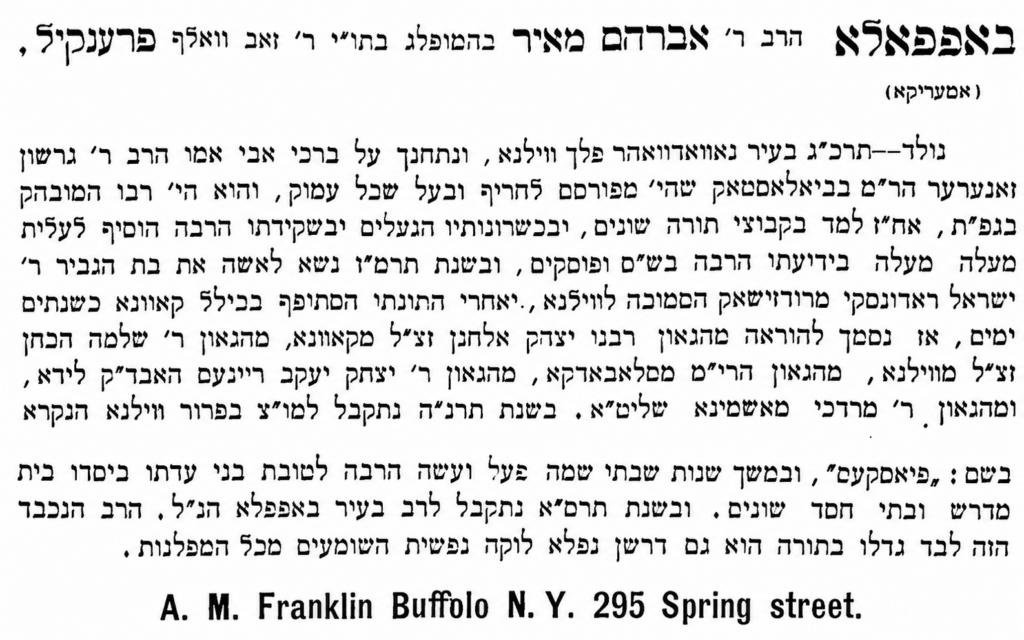
In 5647 (1886–87), Rabbi Franklin married the daughter of R. Yisrael Radonski. Following his marriage, he spent approximately two years studying in the Kovno Kollel.
He received semicha from several leading rabbinic authorities of the generation, including Rabbi Yitzchak Elchanan Spektor of Kovno, Rabbi Shlomo HaKohen of Vilna, and Rabbi Yitzchak Yaakov Reines, Av Beis Din of Lida, as well as other rabbanim.
In 5655 (1894–95), Rabbi Franklin was appointed Moreh Tzedek in Piaskes, a suburb of Vilna. During his years there, he worked extensively on behalf of the local Jewish community, establishing a beis midrash and charitable institutions.
In 5661 (1900–01), Rabbi Franklin was appointed Rav in Buffalo, New York. In addition to his Torah scholarship and rabbinic leadership, he was known as an exceptional darshan, whose sermons captivated his listeners.
His Buffalo address in 1912 was 295 Spring Street.1
In Buffalo, Rabbi Franklin became Rav of Congregation Anshe Emes, an Orthodox congregation on the city’s East Side. After the congregation moved to Hickory Street, it became popularly known as the Little Hickory Shul.
Although Rabbi Franklin came from the Lithuanian Torah world, Anshe Emes included many Jews of Chassidic and other Eastern European backgrounds. Over the following decades, he became one of the most prominent Orthodox rabbinic authorities in Buffalo.
His broader communal role was already evident only a few years after his arrival.
In 1903, following the horrific Kishinev pogrom, Buffalo Jews gathered for a mass meeting to protest the violence and support the victims. Rabbi Franklin was among the speakers, together with another local rabbi and Police Justice Thomas Murphy.2
(To note: In 1919, the Directory of Jewish national and local organizations in the United States list Rabbi Avraham Meir Franklin as Rabbi of Brith Shalom, with no mention of Anshe Emes.3)
Rav Hakollel of Buffalo
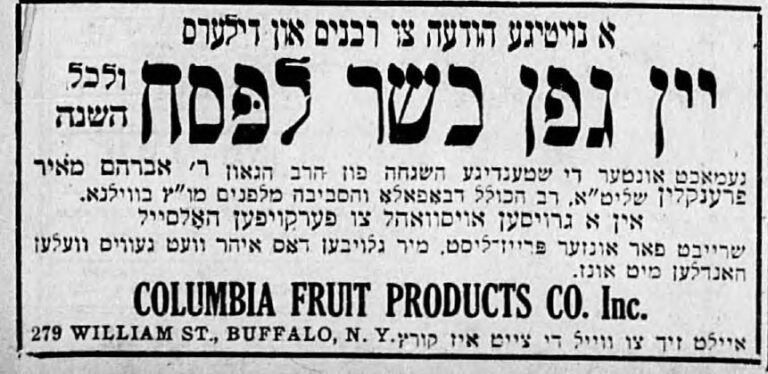
By 1921, Rabbi Franklin was publicly known as:
רב הכולל דבאפאלא והסביבה — “Rav Hakollel of Buffalo and the surrounding area.”
He supervised the production of kosher-for-Pesach wine in Buffalo and was identified as the former Moreh Tzedek of Vilna.
The wine was produced under his constant supervision by Columbia Fruit Products Co., at 279 William Street in Buffalo.4
The same year, Rabbi Franklin’s involvement with sacramental wine brought him into one of the more unusual episodes of his Buffalo rabbinate.
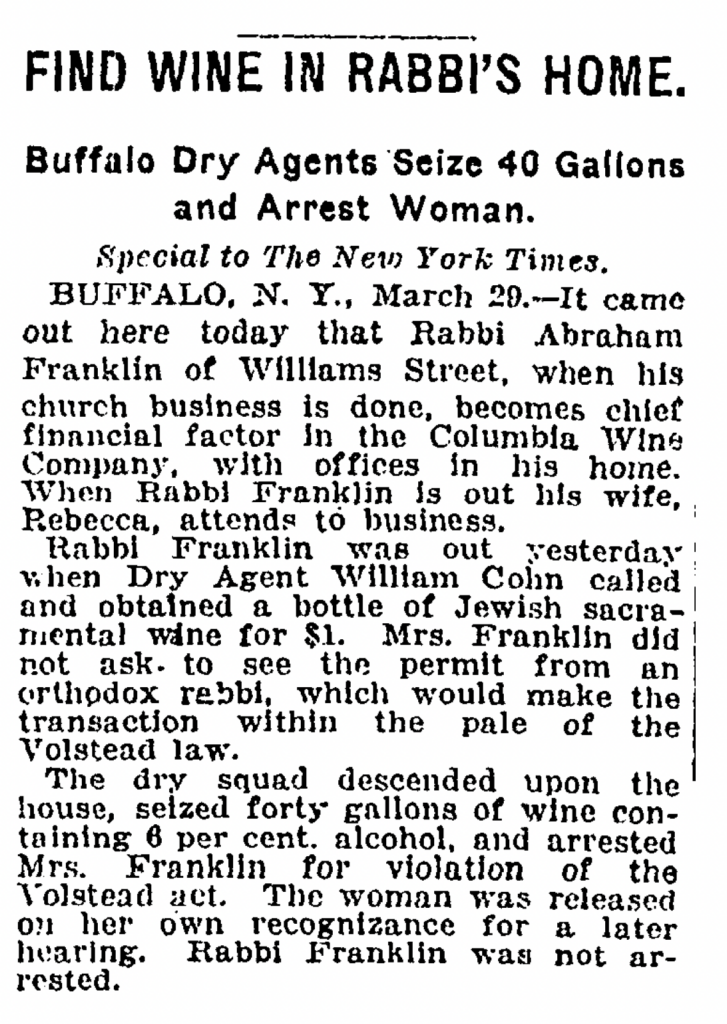
During Prohibition, American law prohibited ordinary alcohol sales while allowing wine for legitimate religious use under regulated circumstances.
In March 1921, a federal Prohibition agent visited the wine business operating from Rabbi Franklin’s home while the rabbi was away. The agent purchased a bottle of Jewish sacramental wine without producing the required Orthodox permit.
Federal agents subsequently seized approximately 40 gallons of wine and arrested Rabbi Franklin’s wife, Rebecca, who handled the transaction while her husband was out. She was released pending a later hearing, and Rabbi Franklin himself was not arrested.5
The incident illustrates one of the unusual challenges faced by American rabbanim during Prohibition: ensuring access to wine for Kiddush and other religious purposes while navigating an entirely new system of federal alcohol regulation.
Chief Rabbi of Buffalo
By the final years of Rabbi Franklin’s life, his standing in Buffalo extended well beyond Anshe Emes.
He was regarded as Buffalo’s “patriarchal rabbi” and as one of the central figures in the city’s Orthodox Jewish life.
Jews throughout Buffalo came to him with questions of Jewish law and communal disputes, and he exercised broad responsibility over kashrus and shechita. Kosher meat sold in Buffalo was subject to rabbinic inspection, and the city’s shochtim operated under religious supervision.
The breadth of Rabbi Franklin’s following became particularly evident at the end of his life. When news of his passing spread, hundreds came to his home, including working-class Jews, businessmen, professionals, fellow rabbanim, cantors and synagogue leaders.
He was remembered as one of Vilna’s distinguished sons, having devoted approximately twenty years to intensive Torah study before entering the rabbinate. He was also identified as a descendant of the Vilna Gaon.
In 1930, Rabbi Franklin was elected vice-president of the Rabbinical Association of America. He was also offered a rabbinic position at the prominent Beth Hamidrash Hagodol in New York, but chose to remain in Buffalo.6
His title of “Chief Rabbi” did not mean that Buffalo had one centralized rabbinate governing every synagogue. Rather, it reflected the unusually broad authority and respect Rabbi Franklin had acquired among the city’s Orthodox congregations.
Rabbi Franklin and Kosher Coca-Cola
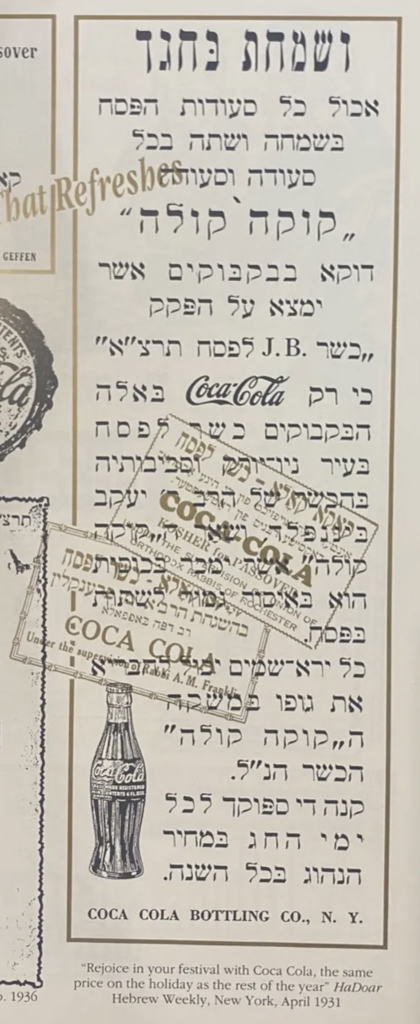
One of the most fascinating aspects of Rabbi Franklin’s career is his place in the early history of Coca-Cola kashrus in America.
The best-known story of kosher Coca-Cola centers on Rabbi Tobias Geffen of Atlanta, whose work with the Coca-Cola Company in the 1930s eventually resulted in ingredient changes that made the beverage acceptable for kosher consumers year-round and for Pesach.
Rabbi Franklin’s involvement with Coca-Cola kashrus began several years earlier.
By April 1930, Coca-Cola was being marketed to Buffalo’s Jewish community under Rabbi Franklin’s kashrus supervision, with additional advertisements appearing in 1931 and 1932.7
An early Coca-Cola Pesach certification bearing Rabbi Franklin’s name states:
“COCA COLA — Under the supervision of Rabbi A. M. Franklin.”
The certification appears together with other early American Coca-Cola Pesach certifications.8
While the exact date of Rabbi Franklin’s Pesach certification is uncertain, Coca-Cola was under his supervision in Buffalo by April 1930.
This places Rabbi Franklin and Buffalo remarkably early in the developing history of kosher Coca-Cola in the United States.
Passing
Rabbi Avraham Meir Franklin passed away on 4 Cheshvan 5693 — November 3, 1932, following an illness of approximately six months.
He passed away at Buffalo General Hospital at the age of 72, with members of his family at his side.
His funeral began at the Franklin family home at 22 Inter Park Avenue. The procession then proceeded to Congregation Anshe Emes on Hickory Street, where additional funeral services were held, before continuing to the Pine Ridge cemetery complex in Cheektowaga.
He was buried in the Anshe Emes Cemetery.


His matzeivah identifies him as:
אב״ד דבאפאלא ולפנים מו״צ בוילנא
Av Beis Din of Buffalo, and formerly a Moreh Tzedek in Vilna.
Its inscription remembers him as a communal leader, posek, adviser and speaker who guided his congregation and administered justice and charity among his people.9
Perhaps the most powerful words engraved on Rabbi Franklin’s matzeivah are ״ויבכו אחריו כל עדת ישראל״ — “And the entire congregation of Israel mourned his passing.” These words speak volumes about the extraordinary place he held in the hearts of Buffalo’s Jewish community. More than a rabbi or respected Torah scholar, he was a beloved spiritual leader whose influence reached across the community. Inscribed in stone more than ninety years ago, these words remain a moving testament to the profound impact he had on Jewish life in Buffalo and the deep sense of loss felt at his passing.
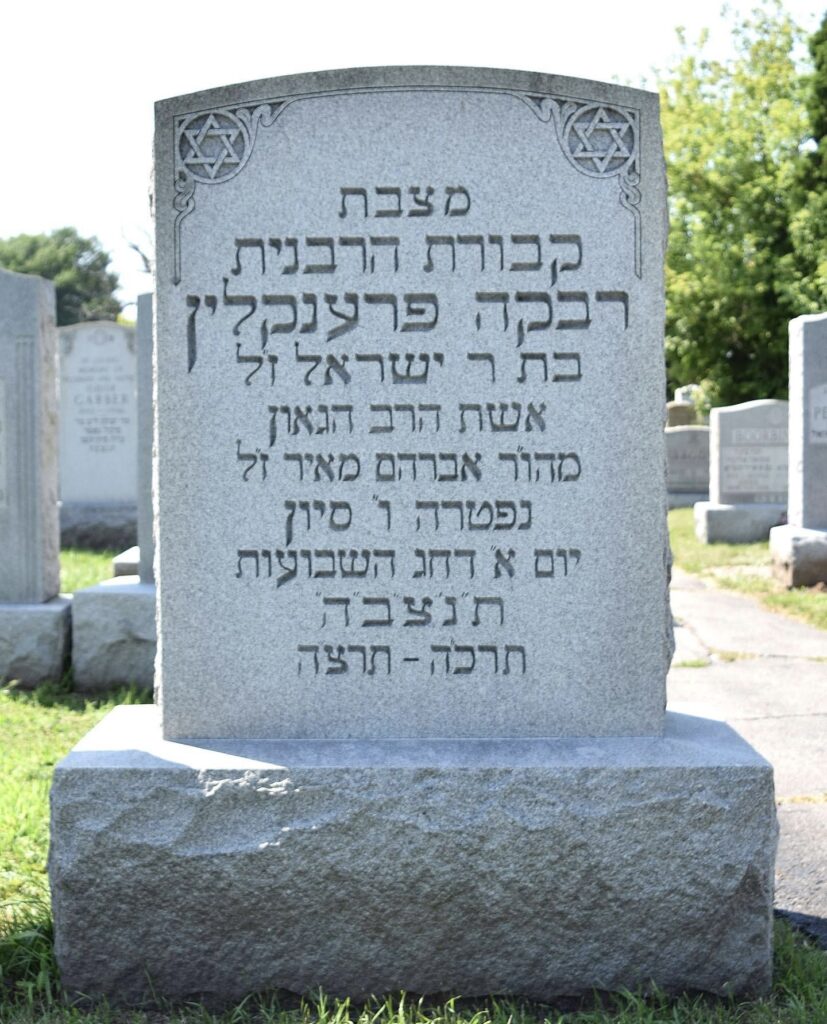
Rabbi Franklin had spent more than three decades helping shape Orthodox Jewish life in Buffalo.
His rabbinic career touched almost every major concern facing an American Orthodox community of that era: synagogue life, kashrus, shechita, mikvaos, Jewish law, communal leadership, aid for Jews overseas, sacramental wine during Prohibition, and the emerging world of industrial kosher certification.
Rebbetzin Rivkah Franklin (רבקה פרענקלין), wife of Rabbi Avraham Meir Franklin, the former Chief Rabbi of Buffalo, passed away on ו׳ סיון תרצ״ה / June 7, 1935, the first day of Shavuos, approximately two and a half years after her husband’s passing in 1932. Her gravestone identifies her as the daughter of Rabbi Yisrael and the wife of Rabbi Avraham Meir Franklin.
More than ninety years after his passing, Rabbi Avraham Meir Franklin deserves to be remembered as one of the central rabbinic figures in the early history of Jewish Buffalo.
Sources & Footnotes
- Rabbi Shmuel Noach Gottlieb, Ohalei Shem (Pinsk, 1912), p. 295. Ohalei Shem is an especially valuable source for Rabbi Franklin’s early life because it was published in 1912, during Rabbi Franklin’s lifetime and while he was serving in Buffalo. Gottlieb compiled the work by corresponding directly with rabbanim throughout the world and requesting biographical information from them. Much of the biographical information was supplied by the rabbis themselves in response to these requests, making Rabbi Franklin’s entry a near-contemporary and essentially first-hand account of his background and rabbinic career. The entry records his birth in 5623 in Novy Dvor, Vilna Governorate; his early Torah education; his marriage; approximately two years of study in the Kovno Kollel; his rabbinic ordinations; his appointment as Moreh Tzedek in Piaskes in 5655; his communal work there; his appointment as Rav in Buffalo in 5661; his reputation as a darshan; and his Buffalo address at 295 Spring Street.
View Ohalei Shem at HebrewBooks
JewishGen — description of Ohalei Shem and its method of compilation ↩︎ - Cyrus Adler, ed., The Voice of America on Kishineff (Philadelphia: Jewish Publication Society of America, 1904), p. 51. This contemporary compilation records the 1903 Buffalo mass meeting responding to the Kishinev pogrom and lists Rabbi Franklin among its speakers.
Read The Voice of America on Kishineff ↩︎ - https://archive.org/details/directoryofjewis00schn/page/432/mode/2up ↩︎
- Yidishes Tageblat, March 3, 1921. A contemporary Yiddish advertisement for kosher-for-Pesach wine identifies Rabbi Franklin as “Rav Hakollel of Buffalo and the surrounding area” and formerly a Moreh Tzedek in Vilna. The advertisement states that the wine was produced under his constant supervision by Columbia Fruit Products Co., 279 William Street, Buffalo.
National Library of Israel — Yiddish newspapers, March 1921 ↩︎ - The New York Times, March 30, 1921. Contemporary reporting on the Prohibition-era incident at Rabbi Franklin’s Buffalo home records the purchase of sacramental wine by a federal agent, the subsequent seizure of approximately 40 gallons of wine, and the arrest of Rabbi Franklin’s wife while the rabbi was away.
View the 1921 New York Times clipping ↩︎ - Buffalo Evening News, November 4, 1932, “City Mourns Death of Rabbi Franklin.” This extensive contemporary obituary records Rabbi Franklin’s Vilna background, Torah education, leadership of Anshe Emes, status in Buffalo’s Orthodox community, involvement in kashrus, shechita and Jewish law, the breadth of his following, his election as vice-president of the Rabbinical Association of America, and details surrounding his final illness, death and funeral.
View the Buffalo Evening News obituary
Library of Congress — Buffalo Evening News archival record ↩︎ - Buffalo Jewish Review, 1930–1932. Contemporary advertisements document Coca-Cola being marketed in Buffalo under Rabbi Franklin’s kashrus supervision beginning by April 1930, with additional advertisements appearing in 1931 and 1932. The Buffalo Jewish Review archive is preserved by the University at Buffalo Libraries.
Buffalo Jewish Review Archive — University at Buffalo Libraries ↩︎ - David Geffen, American Heritage Haggadah: The Passover Experience (Jerusalem: Gefen Publishing, 1992). The Haggadah reproduces a page of early American Coca-Cola Pesach certifications, including one bearing the name Rabbi A. M. Franklin and the words “COCA COLA — Under the supervision of Rabbi A. M. Franklin.”
American Heritage Haggadah — WorldCat bibliographic record
View the reproduced Coca-Cola certification ↩︎ - Matzeivah of Rabbi Avraham Meir Franklin, Anshe Emes Cemetery, Cheektowaga. Rabbi Franklin’s gravestone records his passing on 4 Cheshvan 5693 and identifies him as “אב״ד דבאפאלא ולפנים מו״צ בוילנא” — “Av Beis Din of Buffalo, and formerly a Moreh Tzedek in Vilna.” Its inscription also describes his rabbinic and communal leadership.
Rabbi Avraham Meir Franklin — Kevarim.com ↩︎