Table of Contents
הגאון הרב דוב בעריש בן רבי אהרן צוקרמן ז״ל
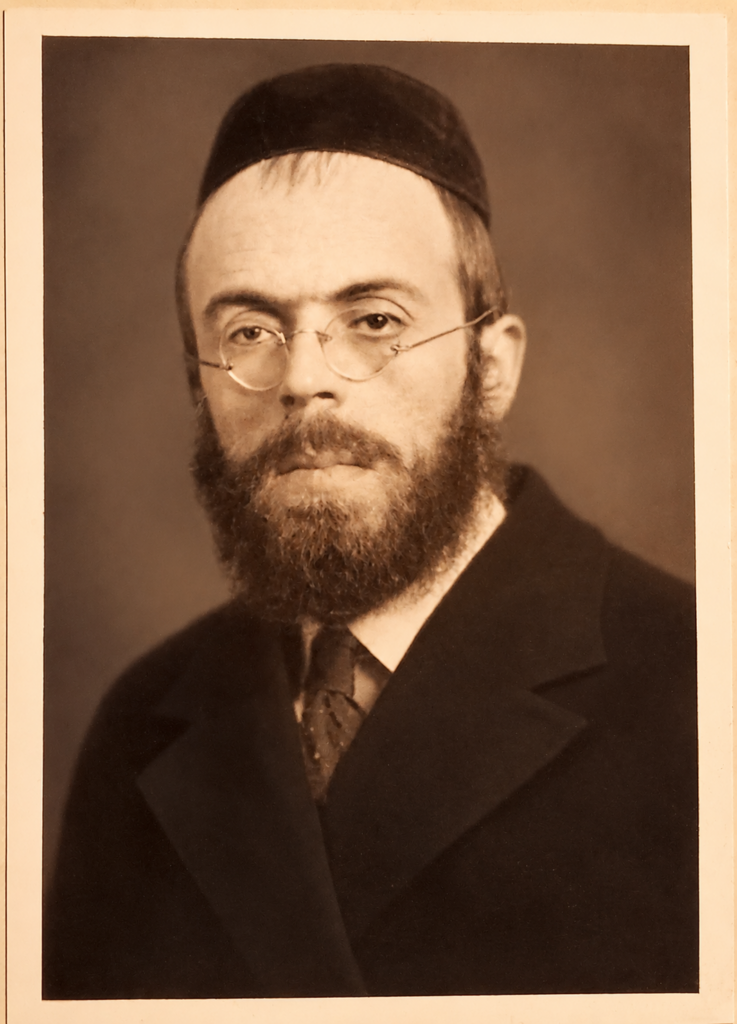
Rabbi Dov Ber (Berish) Zuckerman (1901–1973) was one of the leading Torah scholars and halachic authorities to serve the Jewish community of Buffalo, New York. In 1942, he became rav of the historic Anshe Lubavitz congregation at 113 Pratt Street, beginning an important chapter in Buffalo’s early Lubavitch history.
He later became the longtime rav of Brith Sholem and was widely recognized as Buffalo’s Chief Rabbi. During more than a quarter century in Buffalo, Rabbi Zuckerman became a respected posek whose influence extended throughout Western New York and into the broader American Torah world.
Early Life in Galicia and Europe
Early Life in Galicia and Europe
Rabbi Zuckerman was born on 21 Menachem Av 5661 — August 6, 1901, in Hivniv, Galicia, also rendered Hubniv, approximately 20 kilometers from Belz.
His father, Rabbi Aharon Zuckerman, was a businessman as well as an accomplished Torah scholar and Chassid. His mother, Yocheved Rivka, descended from the rabbinic family of Hivniv. Growing up in the Torah and Chassidic atmosphere of prewar Galicia, Rabbi Zuckerman became closely associated with Belz and remained a Belzer Chassid throughout his life.
In 1929, he married Hinda Bracha Frankel, daughter of Rabbi Dovid Frankel, the rabbi of Husyatin and a noted Torah scholar and collector of Hebrew manuscripts. The couple settled in Lemberg, where Rabbi Zuckerman devoted himself intensively to Torah study and developed a particularly close relationship with the renowned Tchebiner Rav, Rabbi Dov Berish Weidenfeld.
In 1931, the family moved to Vienna. Following the Nazi takeover of Austria, they escaped Europe and arrived in the United States in 1939.1
Before Rabbi Zuckerman: Rabbi Yehoshua Halevi Zambrowsky
Before Rabbi Zuckerman’s arrival, Anshe Lubavitz had been led during the 1930s by Rabbi Yehoshua Halevi Zambrowsky, a distinguished Torah scholar who also served as Chief Rabbi of the Buffalo Council of Jewish Congregations.
Rabbi Zambrowsky remained a leading figure in Buffalo’s Orthodox community until his passing in 1939. Three years later, Rabbi Zuckerman assumed the rabbinate of the historic Pratt Street Lubavitch congregation.2
Read the full biography of Rabbi Yehoshua Halevi Zambrowsky
Buffalo and Anshe Lubavitz
1942: Rav of Anshe Lubavitz
In 1942, Rabbi Zuckerman came to Buffalo and accepted the rabbinate of Anshe Lubavitz, one of the city’s oldest Chassidic congregations.
Anshe Lubavitz had been formally incorporated in 1890 and built its synagogue at 113 Pratt Street in 1911. For decades the congregation was known throughout Buffalo simply as the Pratt Street Shul or Lubavitch Shul.
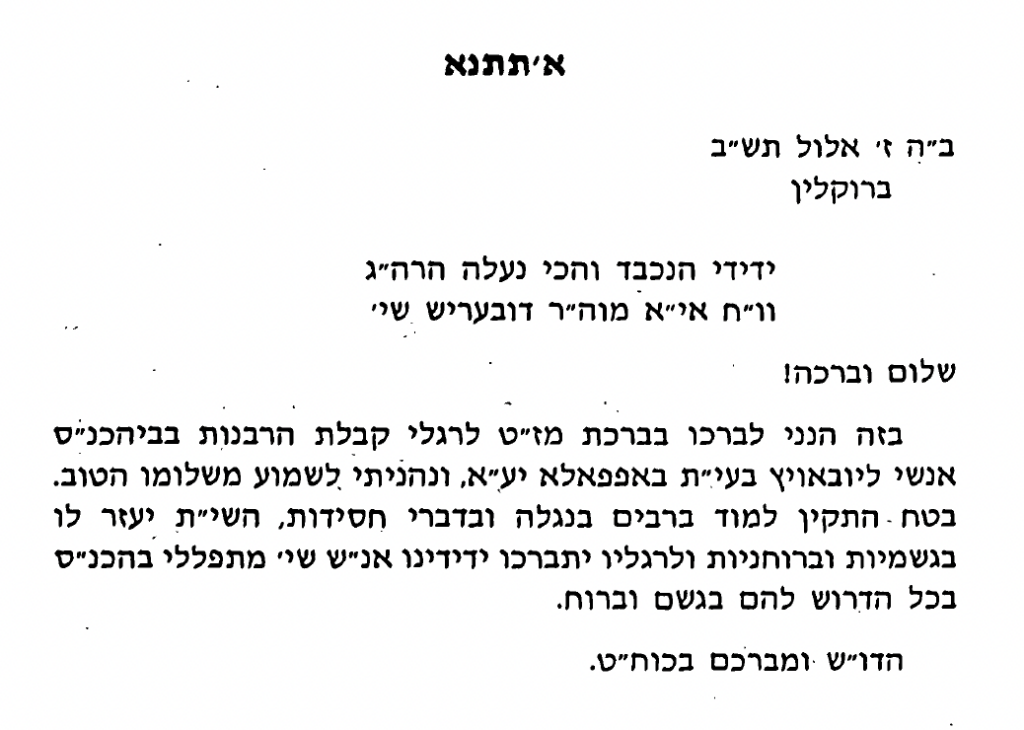
Rabbi Zuckerman’s appointment is preserved in a letter dated 7 Elul 5702 — August 20, 1942, from Rabbi Yosef Yitzchak Schneersohn, the Previous Lubavitcher Rebbe.
The Previous Rebbe congratulated Rabbi Zuckerman upon accepting the rabbinate of the Anshei Lubavitch synagogue in Buffalo and encouraged him to establish public Torah study in both Nigleh and Chassidus. He concluded with blessings for Rabbi Zuckerman and the members of the congregation in all their material and spiritual needs.3
Supporting Yeshivas Achei Tmimim Lubavitch
Rabbi Zuckerman’s role in Buffalo’s Lubavitch community extended beyond the Pratt Street synagogue.
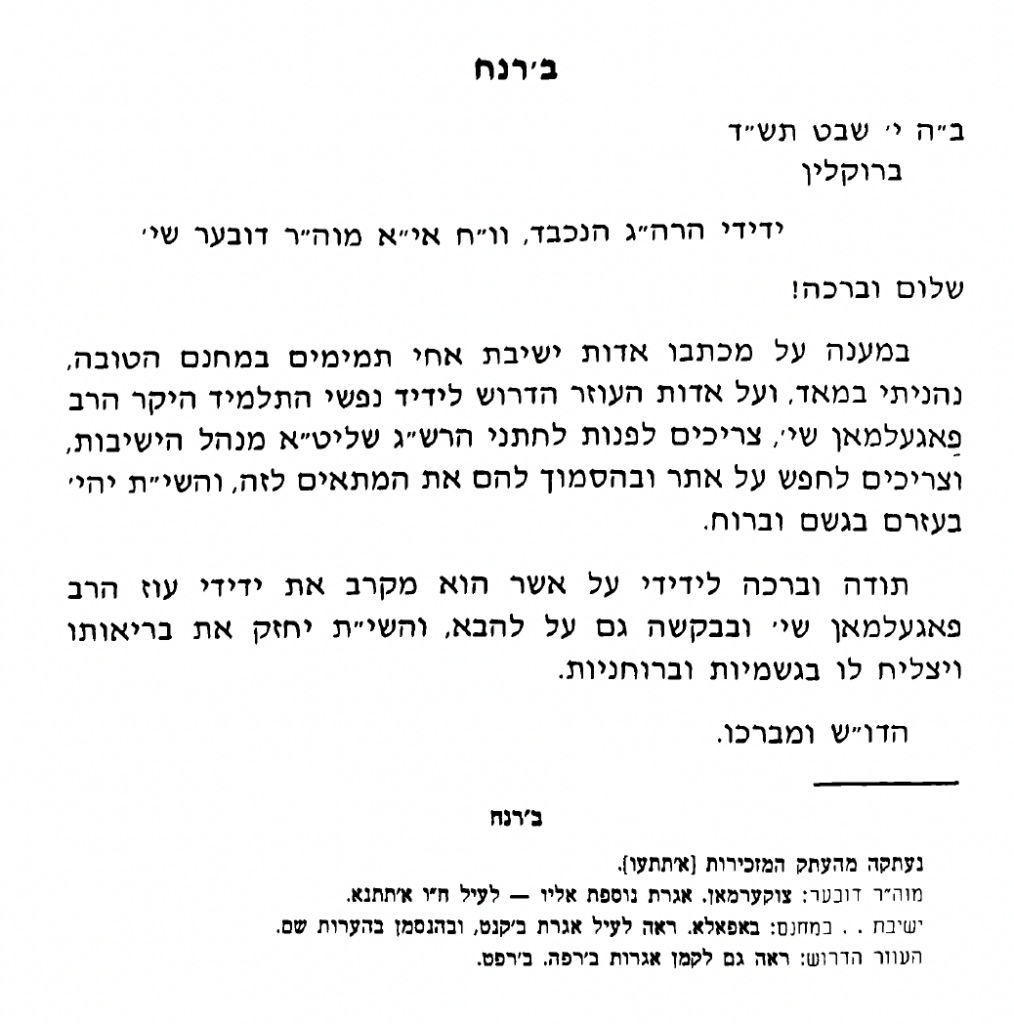
In 1944, he was actively assisting Yeshivas Achei Tmimim Lubavitch, the Chabad yeshiva that had been established in Buffalo the previous year. Rabbi Zuckerman communicated directly with the Previous Rebbe about the yeshiva and the work of its principal, Rabbi Yehuda Tzvi (Hershel) Fogelman.
In a letter dated 10 Shevat 5704 — February 4, 1944, the Previous Rebbe expressed his pleasure at Rabbi Zuckerman’s report concerning the yeshiva, discussed the additional assistance Rabbi Fogelman needed, and specifically thanked Rabbi Zuckerman for supporting him. He asked Rabbi Zuckerman to continue that assistance in the future.4
From Anshe Lubavitz to Brith Sholem
In the mid-1940s, Rabbi Zuckerman concluded his tenure at Anshe Lubavitz and became the rav of Brith Sholem, one of Buffalo’s oldest Orthodox congregations.
Brith Sholem was then located at 171 Pine Street, only a short distance from the Pratt Street Lubavitch Shul. Rabbi Zuckerman followed Rabbi Nissen Markel, who had served Brith Sholem until 1945, and would lead the congregation for approximately the next quarter century.
In 1951, Brith Sholem moved from Pine Street to 1052 Hertel Avenue in North Buffalo, with Rabbi Zuckerman continuing as its rav.
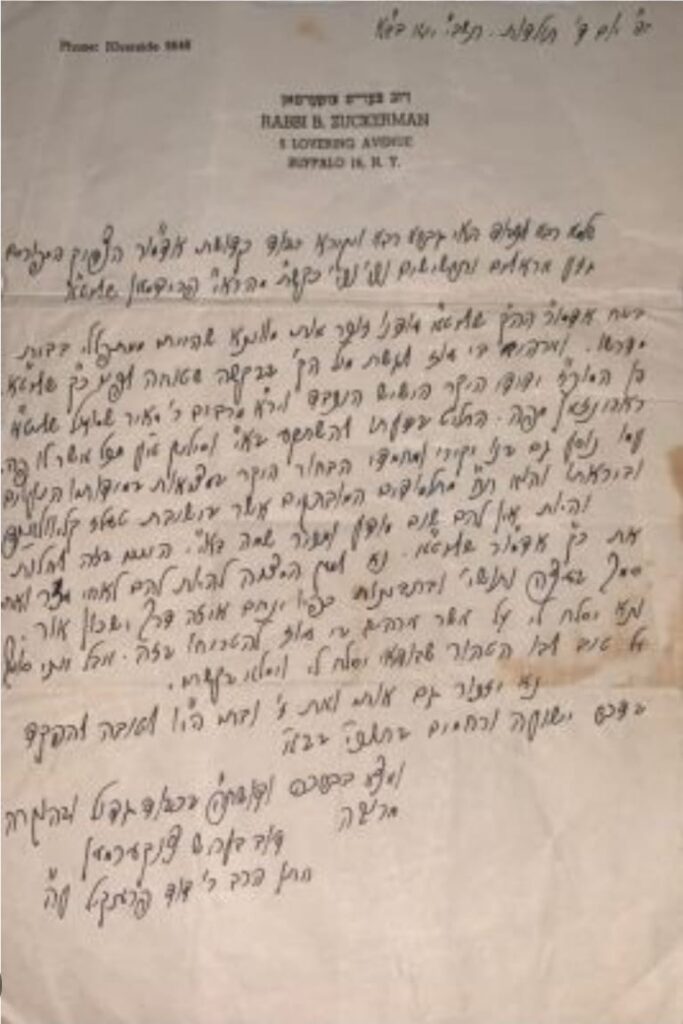
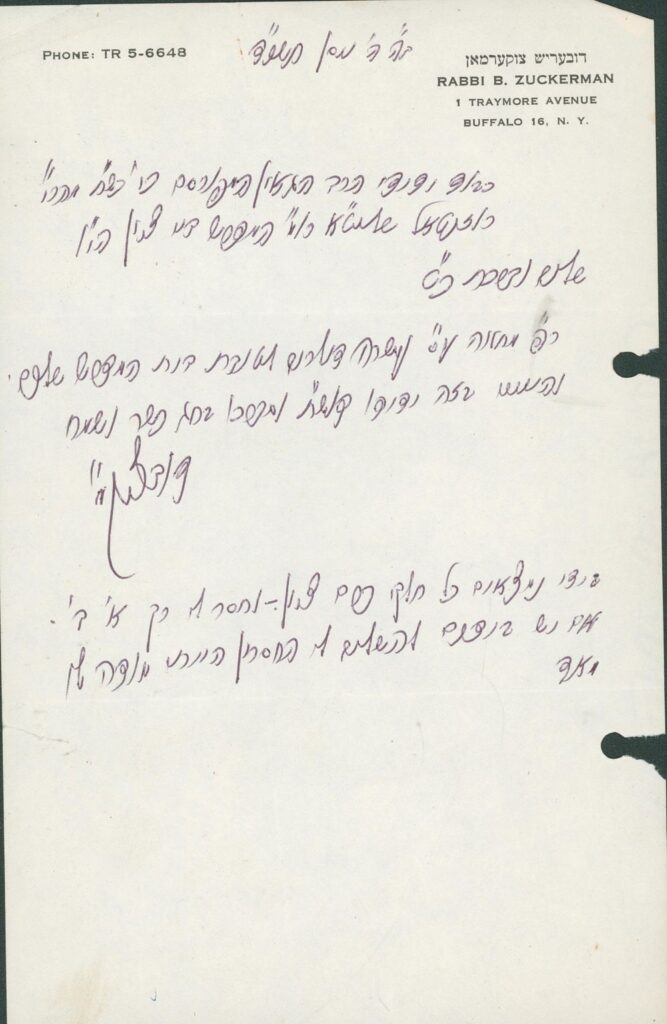
Surviving letters on Rabbi Zuckerman’s personal letterhead from his Buffalo years also list addresses at 1 Traymore Avenue and 5 Lovering Avenue, both near the congregation’s Hertel Avenue location.5
Buffalo’s Chief Rabbi and a Leading Posek
During his years in Buffalo, Rabbi Zuckerman became one of the region’s foremost Orthodox rabbinic authorities and was widely known as Buffalo’s Chief Rabbi.
Rabbi Hershel Fogelman, who knew Rabbi Zuckerman personally while directing Yeshivas Achei Tmimim in Buffalo, later referred to him explicitly as “the chief Rabbi of Buffalo.”
Rabbi Zuckerman’s reputation rested above all on his Torah scholarship. Rabbi Shimon Goldman, who spent several years in Buffalo, remembered him as a gaon and distinguished personality who spent his days and nights immersed in Torah. His home was filled with sefarim and reflected the warmth and atmosphere of the Chassidic world from which he had come.
Jews throughout Buffalo and the surrounding region sought Rabbi Zuckerman’s guidance on difficult questions of Halacha. People traveled even from Rochester to consult him concerning complicated matters of Jewish divorce. He presided over gittin, dealt with sensitive questions involving agunos, and supervised shechita in Buffalo, including personally examining the slaughtering knives and overseeing the work.6
Building the Kenmore Mikvah
Rabbi Zuckerman also played an important role in strengthening Buffalo’s religious infrastructure.
Beginning in 1953, he joined Rabbi Justin Hofmann, Rabbi Samuel Stern and Miriam Stern in laying the groundwork for the Kenmore Mikvah. At the same time, Rebbetzin Devorah Groner, who had been sent to Buffalo with her husband Rabbi Yitzchok Dovid Groner, spearheaded the effort to build a proper women’s mikvah and devoted herself to organizing and raising funds for the project.
The new mikvah was established at 1248 Kenmore Avenue and officially opened on August 4, 1957.
For Rabbi Zuckerman, the project reflected his broader concern that Buffalo possess not merely the basic institutions of Jewish life, but institutions maintained to the highest possible standards of Halacha.7
Correspondence with Leading Torah Authorities
Correspondence with Leading Torah Authorities
Rabbi Zuckerman’s standing in the Torah world is reflected in an extraordinary body of surviving correspondence.
Approximately fifty letters from Rabbi Yosef Eliyahu Henkin, written primarily to Rabbi Zuckerman between 1943 and 1968, discuss difficult halachic matters, particularly gittin and agunos. Rabbi Henkin sometimes addressed Rabbi Zuckerman with the honorific “Alufi,” reflecting the esteem in which he held his Torah scholarship.
In 1949, Rabbi Moshe Feinstein corresponded with Rabbi Zuckerman concerning a difficult postwar agunah case. Rabbi Feinstein ultimately agreed with Rabbi Zuckerman’s conclusion that the woman could be permitted to remarry.
The surviving archive also contains Torah correspondence from Rabbi Mordechai Gifter, the Tchebiner Rav, and other leading rabbinic figures. Together, these letters reveal that the Buffalo rav was participating directly in some of the most difficult halachic discussions confronting American Jewry in the aftermath of the Holocaust.8
His Relationship with the Lubavitcher Rebbe
Rabbi Zuckerman’s personal Torah connection with Lubavitch extended beyond his service at Anshe Lubavitz.
Before the war, while both were in Paris, Rabbi Zuckerman knew the future Lubavitcher Rebbe, Rabbi Menachem M. Schneerson, and later recalled that they had studied Talmud Yerushalmi together. He spoke with exceptional admiration about the Rebbe’s breadth and depth of Torah knowledge.
Their Torah relationship continued during Rabbi Zuckerman’s years in Buffalo.
In 1953, Rabbi Zuckerman sent the Rebbe proofs of his Torah notes on the Meiri. The Rebbe personally reviewed them, responded with detailed comments concerning the laws of mikvah and immersion, and returned the proofs to Rabbi Zuckerman. The published letter identifies its recipient as “Dovberish Zuckerman, Buffalo.”
Another letter in 1958 responded to a further Torah observation submitted by Rabbi Zuckerman.
The Rebbe also sent regards to Rabbi Zuckerman through Rabbi Yitzchok Dovid Groner and encouraged the two Buffalo rabbis to maintain a regular Torah study session together.9
His Torah Writings
His Torah Writings
Rabbi Zuckerman wrote extensively throughout his life. His Torah scholarship embraced the Rambam, Meiri, Tractate Horayot, mikvaos, gittin, and numerous areas of practical Halacha.
Much of his written Torah remained in manuscript during his lifetime.
The Rebbe took a personal interest in ensuring that Rabbi Zuckerman’s Torah writings would eventually be published. Following Rabbi Zuckerman’s passing, the Rebbe encouraged his son-in-law, Rabbi Sholom Rivkin, to prepare the manuscripts for publication.
In a letter dated 4 Shevat 5735 (1975) concerning Rabbi Zuckerman’s notes on the Rambam in light of the Meiri, the Rebbe urged that the material be prepared so that it could be studied publicly and reiterated an offer of financial assistance toward its publication.
Rabbi Zuckerman’s Torah writings were subsequently published under the title Beis Aharon, preserving a portion of the scholarship to which he had devoted his life.10
Later Years and Legacy
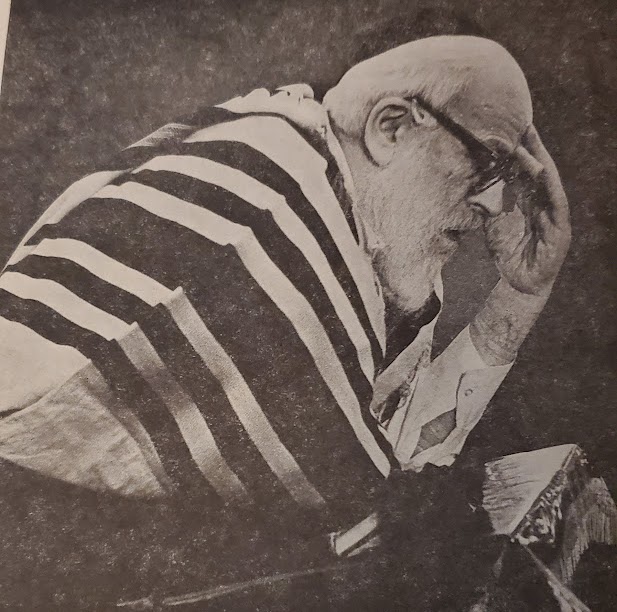
Rabbi Zuckerman remained in Buffalo until 1968, completing more than a quarter century of rabbinic leadership in the city.
He then moved to Boro Park, Brooklyn, where he continued his intensive Torah study and became a source of inspiration to younger scholars who were drawn to the Torah greatness and Chassidic world that he represented.
Rabbi Dov Berish Zuckerman passed away on 18 Adar I 5733 — February 20, 1973, at the age of 71. He was laid to rest in Beth David Cemetery in Elmont, New York.
His legacy continued through his family and through the publication of his Torah writings in Beis Aharon.
Rabbi Zuckerman’s Buffalo years also occupy a unique place in the history of Chabad-Lubavitch in Western New York. He entered Buffalo as the rav of the historic Anshe Lubavitz congregation, received direct guidance and encouragement from the Previous Rebbe, supported the newly established Yeshivas Achei Tmimim, maintained an ongoing Torah relationship with the Rebbe, and remained closely connected with the Chabad leaders working in the city even after moving from Anshe Lubavitz to Brith Sholem.
At the same time, his authority extended far beyond any single congregation. As a posek, communal rav and Torah scholar known throughout the region as the Rav and Chief Rabbi of Buffalo, Rabbi Dov Berish Zuckerman became an important link between Buffalo’s historic Lubavitch community and the broader world of twentieth-century American Torah scholarship.11
Sources, Footnotes & Links
- BoroPark24, “Memory Lane: Rav Dov Berish Zuckerman, zt”l,” May 25, 2024.
The biographical account records Rabbi Zuckerman’s birth in Hivniv in 1901, his parents Rabbi Aharon and Yocheved Rivka, his upbringing near Belz, his Belzer Chassidic background, his marriage to Hinda Bracha Frankel, his years in Lemberg and Vienna, and the family’s escape from Europe and arrival in the United States in 1939.
It also preserves family recollections of Rabbi Zuckerman’s extraordinary dedication to Torah study and his continuing attachment to Belz.
BoroPark24 — Memory Lane: Rav Dov Berish Zuckerman ↩︎ - Louis Silverstein, “Buffalo’s Last Shochet Describes Jewish Community Since 1920’s,” Buffalo Jewish Review Supplement, July 9, 1976, p. 2; contemporary 1933 reporting concerning Rabbi Yehoshua Zambrowsky’s appointment as Chief Rabbi in Buffalo.
Silverstein, who had lived in Buffalo since 1923 and was personally familiar with the city’s Orthodox synagogues, identified Rabbi Zambrowsky directly as the rabbi of the Pratt Street Lubavitch congregation, recalling:
“The Lubavitch Shule on Pratt Street had Rabbi Joshua Zambrowsky.”
Contemporary 1933 reports independently establish Rabbi Zambrowsky as Chief Rabbi of the Buffalo Council of Jewish Congregations. He died in Buffalo in 1939. The evidence does not presently establish who, if anyone, formally held the Anshe Lubavitz pulpit during the three-year period between Rabbi Zambrowsky’s death and Rabbi Zuckerman’s appointment in 1942; for that reason, Rabbi Zuckerman should not be described as having directly “succeeded” Rabbi Zambrowsky.
Jewish Buffalo History Center — Buffalo’s Last Shochet ↩︎ - Rabbi Yosef Yitzchak Schneersohn, Igros Kodesh, Vol. 6, p. 409, letter dated 7 Elul 5702 (August 20, 1942); Jewish Buffalo History Center, “Anshe Lubavitz.”
The letter is direct contemporary documentation of Rabbi Zuckerman’s appointment. The Previous Rebbe addresses Rabbi Zuckerman upon his acceptance of the rabbinate of Anshei Lubavitch in Buffalo, encourages the establishment of public study in both the revealed portions of Torah and Chassidus, and blesses Rabbi Zuckerman and the congregation.
The Jewish Buffalo History Center documents Anshe Lubavitz’s incorporation in 1890, the construction of its synagogue at 113 Pratt Street in 1911, and its longstanding identification as the Pratt Street Shul.
Jewish Buffalo History Center — Anshe Lubavitz ↩︎ - Rabbi Yosef Yitzchak Schneersohn, letter to Rabbi Dov Berish Zuckerman, 10 Shevat 5704 (February 4, 1944).
The letter responds directly to a report sent by Rabbi Zuckerman concerning Yeshivas Achei Tmimim in Buffalo. The Previous Rebbe expressed satisfaction with the report, discussed obtaining assistance for Rabbi Hershel Fogelman, directed that the matter also be addressed through his son-in-law Rabbi Shemaryahu Gurary (Rashag), director of the Lubavitch yeshivos, and thanked Rabbi Zuckerman for the support he was already providing Rabbi Fogelman. ↩︎ - Jewish Buffalo History Center, “Brith Sholem”; surviving Rabbi Dov Berish Zuckerman personal correspondence.
The Jewish Buffalo History Center identifies Rabbi Nissen Markel as Brith Sholem’s rabbi until 1945, followed by Rabbi Zuckerman, whom it describes as a major Talmudic authority who led Brith Sholem for approximately the next quarter century. The congregation was located at 171 Pine Street from 1893 through 1950 and moved to 1052 Hertel Avenue in 1951.
The addresses at 1 Traymore Avenue and 5 Lovering Avenue appear on surviving examples of Rabbi Zuckerman’s personal Buffalo letterhead.
Jewish Buffalo History Center — Brith Sholem ↩︎ - Rabbi Hershel Fogelman, “Stories and Memories,” in Memento from the Wedding of Rabbi Mendel & Mushkie Fogelman, 2 Marcheshvan 5775 (October 26, 2014), Story 15; Rabbi Shimon Goldman, From Shedlitz to Safety, pp. 184–185.
Rabbi Fogelman personally lived and worked in Buffalo during Rabbi Zuckerman’s early years there and explicitly identifies Rabbi Zuckerman as “the chief Rabbi of Buffalo.”
Rabbi Shimon Goldman’s memoir provides one of the strongest firsthand descriptions of Rabbi Zuckerman in Buffalo. Goldman describes his exceptional Torah learning and piety, the warm Chassidic atmosphere of his home, the high regard in which the Previous Rebbe held him, Jews traveling from Rochester to seek his rulings, his involvement in gittin, and his supervision of shechita.
Fogelman–Baron Teshura — Stories and Memories ↩︎
Rabbi Sholom Rivkin, introduction to Rabbi Dov Berish Zuckerman’s Beis Aharon; Jewish Buffalo History Center, “Brith Sholem” and “Mikvah”; Menachem Posner, “Mrs. Devorah Groner, 92, Pioneering Australian Jewish Leader,” Chabad.org, May 28, 2018.
Rabbi Zuckerman’s son-in-law Rabbi Sholom Rivkin records Rabbi Zuckerman’s extensive efforts on behalf of mikvah in Buffalo, including fundraising and his concern for both its halachic standards and physical quality.
The Jewish Buffalo History Center records that in 1953 Rabbi Zuckerman, Rabbi Justin Hofmann, Rabbi Samuel Stern and Miriam Stern began the groundwork for the Kenmore Mikvah, which opened in 1957 at 1248 Kenmore Avenue. Its dedicated mikvah history gives the opening date as August 4, 1957.
Chabad.org independently records that Devorah Groner was instrumental in building Buffalo’s women’s mikvah, spearheaded the project and raised significant funds for it.
Jewish Buffalo History Center — History of the Kenmore Mikvah
Chabad.org — Rebbetzin Devorah Groner biography ↩︎- Kestenbaum & Company, Auction 58, particularly Lots 356, 359, 364 and related Zuckerman family correspondence.
Lot 364 contains approximately fifty letters from Rabbi Yosef Eliyahu Henkin, mostly written to Rabbi Zuckerman in Buffalo between 1943 and 1968, dealing extensively with gittin and agunos. The catalogue notes Rabbi Henkin’s close relationship with Rabbi Zuckerman and his use of the title “Alufi.”
Lot 356 contains two 1949 letters from Rabbi Moshe Feinstein to Rabbi Zuckerman regarding a Holocaust-era agunah, together with follow-up material from the Beis Din of the Union of Orthodox Rabbis.
Other lots include letters from Rabbi Mordechai Gifter and the Tchebiner Rav, as well as correspondence from major rabbinic and Chassidic figures.
Kestenbaum Auction 58 — Zuckerman correspondence collection ↩︎ - Rabbi Menachem M. Schneerson, Igros Kodesh, Vol. 7, Letter 2030, 1 Adar 5713 (1953); Yemei Melech, recollections transmitted by Rabbi Yitzchok Dovid Groner.
The 1953 letter is addressed directly to Rabbi Dovberish Zuckerman of Buffalo and discusses the proofs Rabbi Zuckerman had submitted containing his notes on the Meiri, particularly questions concerning mikvaos. The Rebbe explains that despite limited time, he reviewed the material out of regard for Rabbi Zuckerman and proceeds to discuss several of his Torah arguments in detail.
The recollection concerning Rabbi Zuckerman’s acquaintance with the future Rebbe in Paris and their study of Talmud Yerushalmi was transmitted by Rabbi Yitzchok Dovid Groner and recorded in Yemei Melech.
1953 letter from the Rebbe to Rabbi Dov Berish Zuckerman ↩︎ - Rabbi Mordechai Menashe Laufer, “Books and Their Authors,” discussing the Rebbe’s correspondence concerning the publication of Rabbi Dov Berish Zuckerman’s writings; Beis Aharon.
The published material reproduces the Rebbe’s letter of 4 Shevat 5735, written to Rabbi Sholom Rivkin, encouraging publication of Rabbi Zuckerman’s notes on the Rambam and Meiri so that they would be available for public Torah study. The Rebbe also reiterated that financial assistance could be made available toward the publication.
The same discussion records that the Rebbe had already corresponded directly with Rabbi Zuckerman in 1953 regarding his proofs on the Meiri.
Chabad — Books and Their Authors: Rabbi Zuckerman and Beis Aharon ↩︎ - BoroPark24, “Memory Lane: Rav Dov Berish Zuckerman, zt”l”; Buffalo Jewish historical records; Kevarim cemetery documentation.
Rabbi Zuckerman remained in Buffalo until 1968 before settling in Boro Park. He passed away on 18 Adar I 5733 (February 20, 1973). Contemporary and later biographical material preserves his reputation as an extraordinary Torah scholar who continued learning intensely until the end of his life.
His Buffalo obituary appeared under the spelling “Bericz Zuckerman” in local death indexes.
His burial is recorded at Beth David Cemetery, Elmont, New York.
Kevarim — Rabbi Dov Berish Zuckerman ↩︎