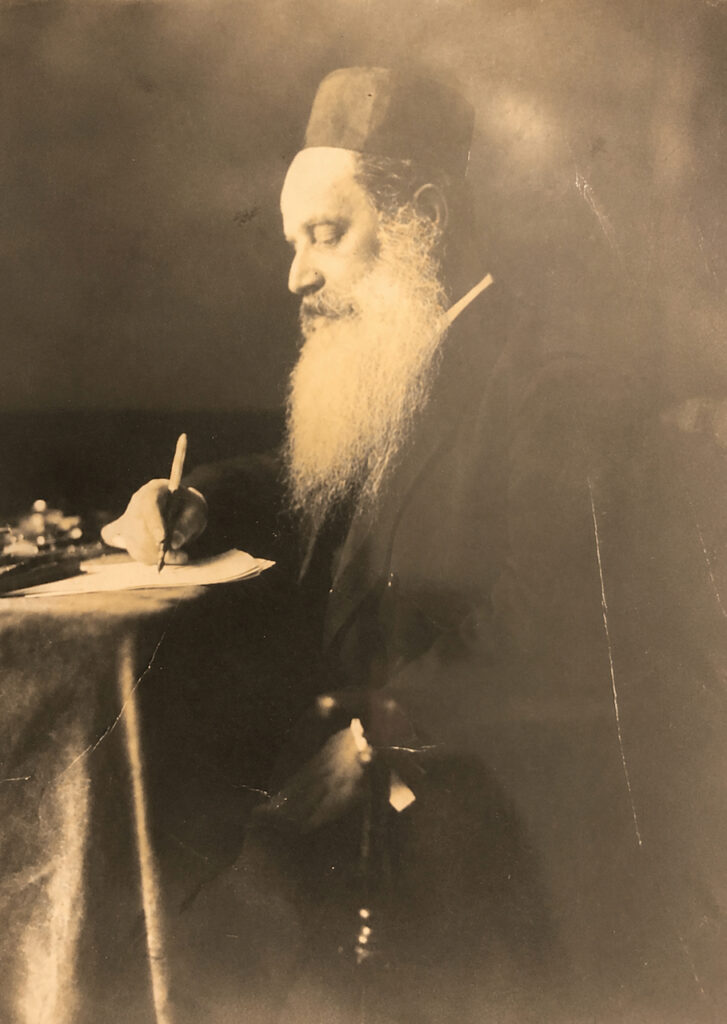
הרב יהושע בן רבי ישראל יצחק הלוי זאמבראסקי ז״ל
Chief Rabbi of Buffalo 1933-1939
Yahrzeit: 11 Elul | יארצייט: י״א אלול
Kever Location: Lubavitz Synagogue Cemetery, 576 Pine Ridge Heritage Blvd, Cheektowaga, NY 14225.
Directions: Row 15, Column 6
https://maps.app.goo.gl/bddB6AA6AGdAHVH87
Table of Contents
Rabbi Yehoshua Halevi Zambrowsky (1874–1939) was the rav of Anshe Lubavitz at 113 Pratt Street and one of the foremost Orthodox rabbinic leaders in Buffalo during the 1930s. During the same period that he led Buffalo’s historic Lubavitch congregation, he served as Chief Rabbi of the Buffalo Council of Jewish Congregations, giving the rav of Anshe Lubavitz a prominent role in the wider religious life of the city.
From Warsaw to America
Rabbi Zambrowsky was born in Warsaw on June 20, 1874, the son of Rabbi Yisrael Yitzchak Halevi Zambrowsky, a distinguished rabbinic scholar and dayan. He spent more than two decades serving the Jewish community of Warsaw before leaving Poland for the United States in 1923.
His life in Warsaw was already marked by Torah scholarship and authorship. In 1907, he published Ateret Yehoshua, a commentary on Tehillim. His rabbinic world also included ties to the Grodzisk Chassidic circle, placing his own early Chassidic background within the Polish Chassidic world long before he later became the rav of Buffalo’s Lubavitch congregation.1
Rabbi Zambrowsky in Syracuse
After arriving in the United States in 1923, Rabbi Zambrowsky settled in Syracuse, New York, where he became the spiritual leader of Congregation Poiley Tzedeck. His responsibilities extended far beyond the synagogue. He served as Jewish chaplain at the Onondaga County Home and Sanatorium and the Jamesville Penitentiary, and he headed the Education Board of the Hebrew Free School, taking an active role in Jewish education throughout the city. He also became active in the Mizrachi movement.
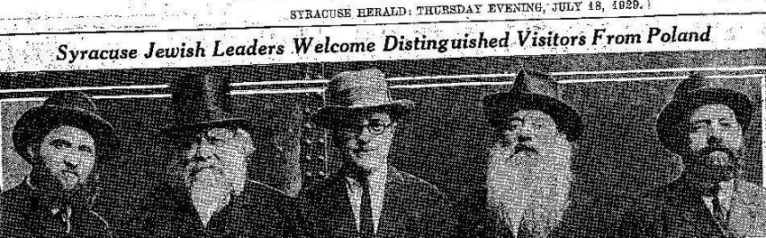
Reb Yehoshua (second from right) pictured alongside prominent Rabbonim at a reception honoring the renowned Torah scholar Harav Baruch Ber Leibowitz of Kamenitz during his historic visit to the United States in 1929. (Photo Source: Syracuse Herald, July 18, 1929.)
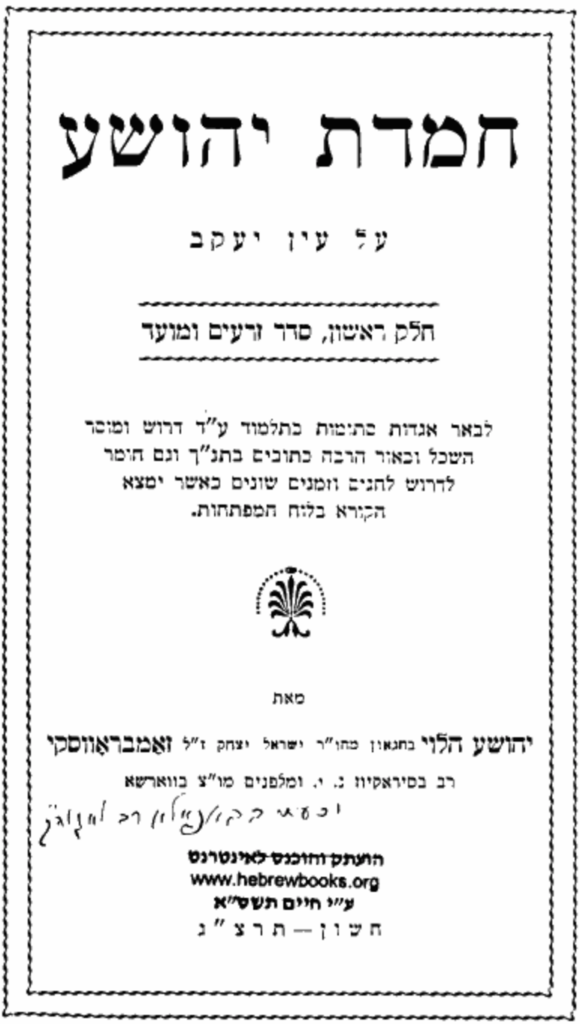
During his American years he published Chemdat Yehoshua, devoted to the Aggadic teachings of Ein Yaakov. His reputation as a Torah scholar, communal rabbi and public leader ultimately led Buffalo’s Orthodox community to call him westward in 1933.2
1933: Rav of Anshe Lubavitz in Buffalo
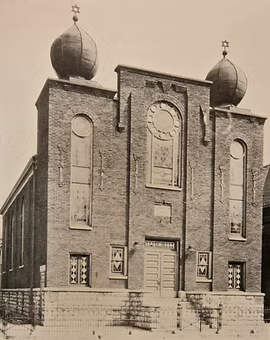
In 1933, Rabbi Zambrowsky came to Buffalo and became the rav of Anshe Lubavitz at 113 Pratt Street, the historic congregation known throughout the community as the Lubavitch Shul or Pratt Street Shul.
Anshe Lubavitz was one of Buffalo’s longstanding Orthodox congregations, and Rabbi Zambrowsky brought to its pulpit decades of rabbinic experience in Warsaw and Syracuse. His tenure placed Anshe Lubavitz at the center of an important period in Buffalo’s Orthodox rabbinic history.3
Chief Rabbi of Buffalo’s Orthodox Community
Rabbi Zambrowsky’s role in Buffalo extended far beyond Anshe Lubavitz. Upon his arrival, he assumed leadership of the city’s Orthodox Jewish community as Chief Rabbi of the Buffalo Council of Jewish Congregations.
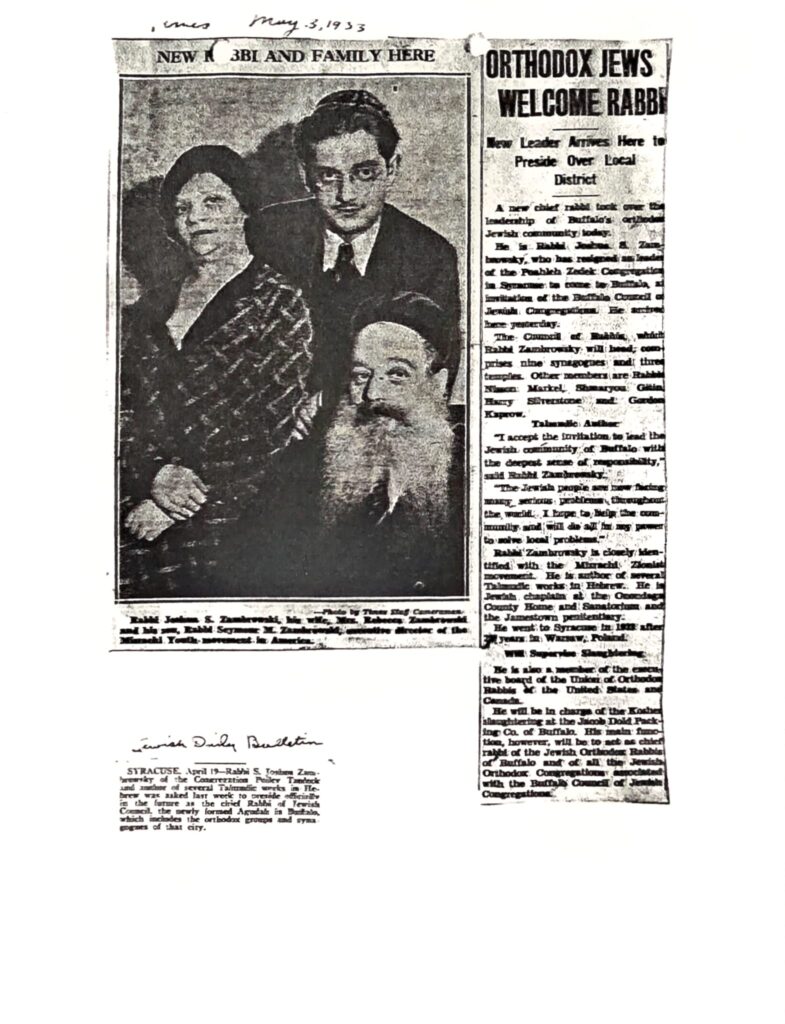
A Buffalo newspaper welcomed his arrival in May 1933 under the headline “Orthodox Jews Welcome Rabbi”, announcing that a new chief rabbi had taken leadership of Buffalo’s Orthodox Jewish community. The Council comprised nine synagogues and three temples, with Rabbi Zambrowsky presiding over its affiliated Orthodox congregations. Other members were Rabbi Nisan Markel, Shmaryahu Gitin, Harry Silverstone and Gordon Kaprov.
His arrival came only months after the passing in 1932 of Rabbi Avraham Meir Franklin, who had been recognized as Buffalo’s Chief Rabbi and Av Beis Din. Rabbi Zambrowsky became the next major Orthodox rabbinic figure in the city to bear the title of Chief Rabbi.4
Kashrus and Communal Leadership
One of Rabbi Zambrowsky’s major responsibilities in Buffalo was the supervision of kashrus. He was placed in charge of kosher slaughter at the Jacob Dold Packing Company, one of Buffalo’s major meatpacking operations.
Only months after arriving in Buffalo, Rabbi Zambrowsky was appointed an inspector in the New York State Department of Agriculture and Markets, supervising the enforcement of state laws relating to kashrus. He also served on the executive board of the Union of Orthodox Rabbis of the United States.
Rabbi Zambrowsky remained deeply active in Mizrachi, serving on its National Executive. His standing brought him into public communal events throughout the region, representing Buffalo’s Orthodox rabbinate alongside other leading American rabbanim.5
A Torah Author
Rabbi Zambrowsky left behind an enduring Torah legacy through his writings.
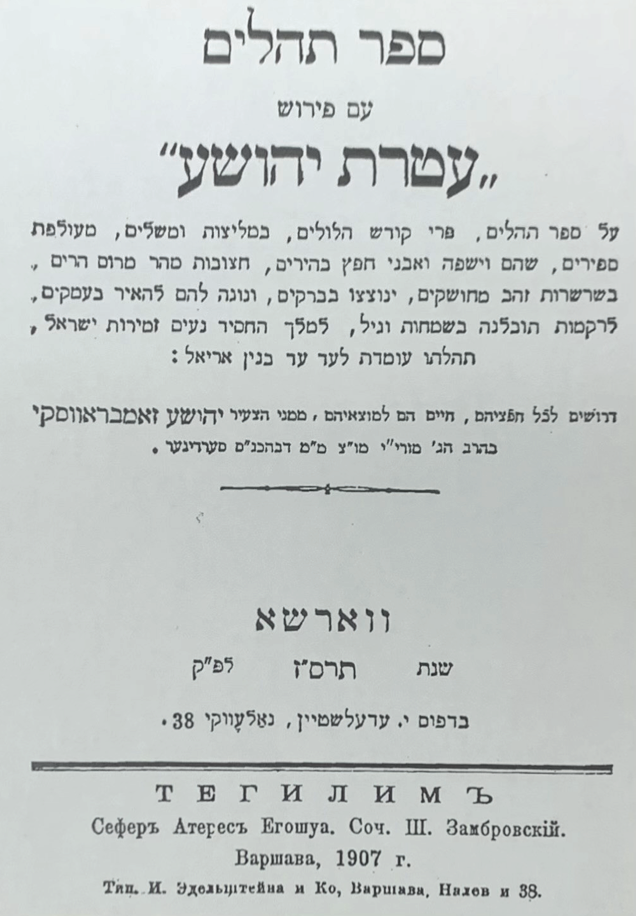
His Ateret Yehoshua, published in Warsaw in 1907, was written as a commentary on Tehillim. The sefer received approbations from prominent rabbinic scholars. One of them, Rabbi Shimon Sofer, praised Rabbi Zambrowsky as a formidable scholar and described him with the phrase “ותלמודו בידו” — his Torah learning was in his hand. Link to the Sefer on Hebrew Books: https://www.hebrewbooks.org/6088
His later Chemdat Yehoshua developed explanations of the Aggadic passages of Ein Yaakov. Link to the Sefer on Hebrew Books: https://www.hebrewbooks.org/3154
His gravestone in Buffalo would ultimately memorialize him not only as a rabbinic leader but specifically as the “author of the sefer Chemdat Yehoshua.”6
His Family
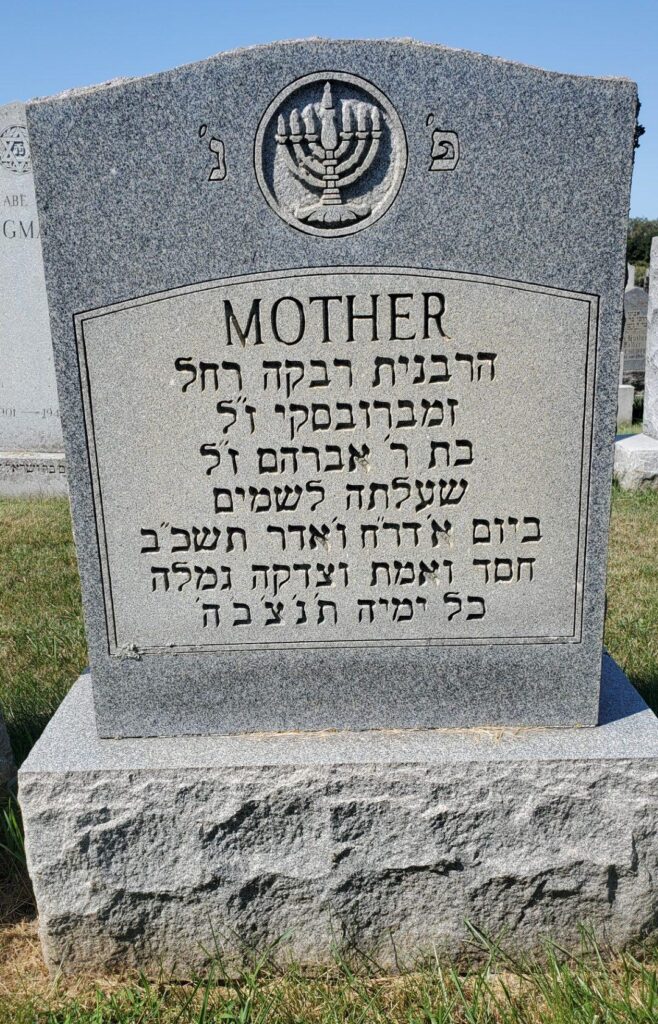
Rabbi Zambrowsky came to Buffalo with his wife Rivka. His children continued the family’s rabbinic and communal legacy.
His son Rabbi Eliezer Elimelech Zambrowsky served as a rabbi in Syracuse and passed away there in 1931, during his father’s lifetime. Another son, Rabbi Tzemach Menachem “Seymour” Zambrowsky, became a prominent Mizrachi leader and communal rabbi, eventually serving in leadership positions in Canada and Israel.7
Passing and Burial in the Lubavitz Cemetery
Rabbi Zambrowsky remained at the center of Buffalo’s Orthodox rabbinate until his passing on Shabbos, 11 Elul 5699 — August 26, 1939, at the age of 65. He had served for six years as Chief Rabbi of the Buffalo Council of Jewish Congregations and had become known throughout the region as a prominent rabbinic leader and orator. He died after an illness of several weeks.
He was laid to rest in the Lubavitz Congregation Cemetery in Cheektowaga, preserving another direct connection between his life and Buffalo’s historic Lubavitch community.8
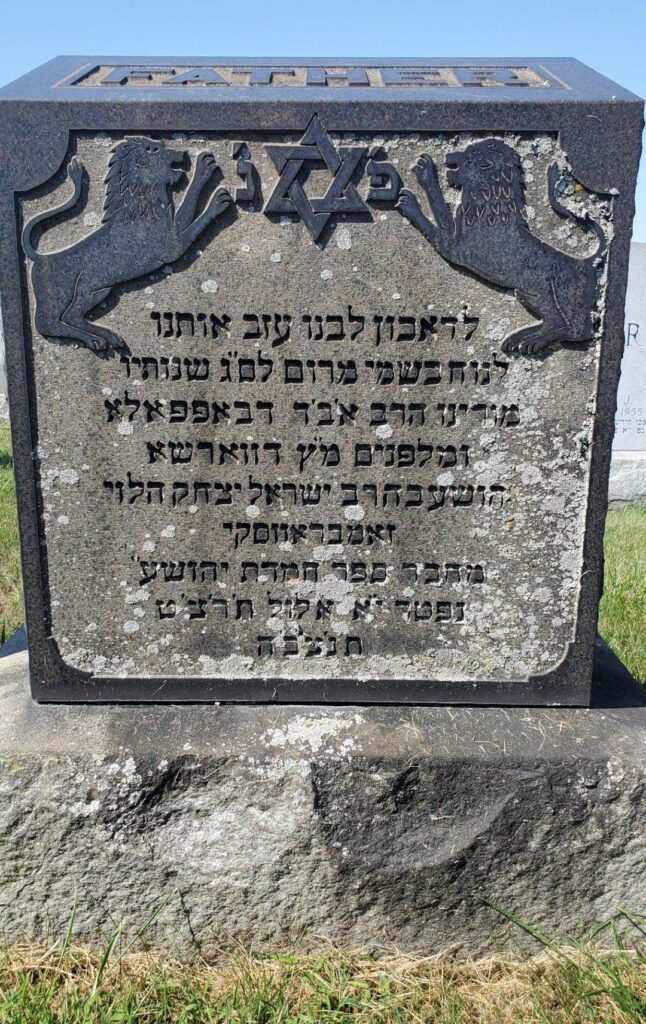
His gravestone describes him as:
הרב אב״ד דבאפפאלא ומלפנים מ״ץ דווארשא
יהושע ב״ר ישראל יצחק הלוי זאמבראסקי
מחבר ספר חמדת יהושע
נפטר י״א אלול תרצ״ט
Rabbi Yehoshua son of Rabbi Yisrael Yitzchak Halevi Zambrowsky, Av Beis Din of Buffalo, formerly of the Warsaw community, author of Chemdat Yehoshua, who passed away on 11 Elul 5699.9
Rabbi Zambrowsky’s Place in Buffalo’s Lubavitch History
Rabbi Yehoshua Zambrowsky’s years at Anshe Lubavitz form an important chapter in the history of Chabad-Lubavitch in Buffalo. A rabbi who had spent decades in the rabbinate in Poland and Syracuse became the rav of the Pratt Street Lubavitch Shul while simultaneously occupying one of the most prominent Orthodox rabbinic positions in the city.
His death in 1939 ended that chapter. In 1942, Rabbi Dov Ber (Berish) Zuckerman accepted the rabbinate of Anshe Lubavitz, continuing the line of rabbinic leadership at the historic Pratt Street congregation.
Sources, Footnotes & Links
- American Jewish Archives, The Concise Dictionary of American Jewish Biography, entry “Zambrowsky, Joshua (S Joshua)”; Jewish Telegraphic Agency, “Buffalo’s Chief Rabbi Selected in Syracuse,” April 30, 1933; Ateret Yehoshua, Warsaw, 5667/1907; Rev. Amiel Bender, “With His Talmud in His Hand,” Congregation Tifereth Beth David Jerusalem, March 30, 2024.
The American Jewish Archives gives Rabbi Zambrowsky’s birth as June 20, 1874 in Warsaw and his immigration to the United States in 1923. A contemporary JTA report states that before coming to Syracuse he had served a congregation in Warsaw for 22 years. Bibliographic records identify Ateret Yehoshua as his commentary on Tehillim, published in Warsaw in 1907. His great-grandson, Rev. Amiel Bender, preserves family material concerning the sefer and its haskamos, including the praise of Rabbi Shimon Sofer for Rabbi Zambrowsky’s Torah scholarship.
A surviving Hebrew biographical notice also identifies Rabbi Zambrowsky as the son of Rabbi Yisrael Yitzchak Halevi Zambrowsky and describes his connection with the Grodzisk Chassidic court. His gravestone independently identifies his father as Rabbi Yisrael Yitzchak Halevi.
American Jewish Archives — Concise Dictionary entry
JTA — Buffalo’s Chief Rabbi Selected in Syracuse, April 30, 1933
Rev. Amiel Bender — With His Talmud in His Hand ↩︎ - Jewish Telegraphic Agency, “Buffalo’s Chief Rabbi Selected in Syracuse,” April 30, 1933; “Rabbi Braude Appointed Chaplain,” June 28, 1933; bibliographic record for Chemdat Yehoshua, St. Louis, 5693/1932–33.
JTA identifies Rabbi Zambrowsky as the longtime spiritual leader of Congregation Poiley Tzedeck and records his service as Jewish chaplain at the Onondaga County Home and Sanatorium and the Jamesville Penitentiary. When he left Syracuse for Buffalo, Moses J. Braude was appointed to succeed him in the two chaplaincy positions. JTA also describes Zambrowsky as an author of Hebrew Talmudic works and a leader in the Mizrachi movement.
The bibliographic catalog of Otzar HaChochma identifies Chemdat Yehoshua by יהושע בן ישראל יצחק הלוי זאמברובסקי, printed in St. Louis in 5693.
JTA — Buffalo’s Chief Rabbi Selected in Syracuse
JTA — Rabbi Braude Appointed Chaplain ↩︎ - Louis Silverstein, “Buffalo’s Last Shochet Describes Jewish Community Since 1920’s,” Buffalo Jewish Review Supplement, July 9, 1976, p. 2.
Louis Silverstein, who arrived in Buffalo in 1923 and was deeply involved in the city’s Orthodox Jewish community, later identified the rabbis of Buffalo’s East Side congregations. In describing Anshe Lubavitz he stated directly:
“The Lubavitch Shule on Pratt Street had Rabbi Joshua Zambrowsky.”
This firsthand recollection directly establishes Rabbi Zambrowsky as the rabbi of Anshe Lubavitz on Pratt Street. Contemporary sources independently establish that he arrived in Buffalo in 1933 and remained in the city through his passing in 1939. The surviving material does not yet establish the exact date during 1933 on which he formally assumed the Anshe Lubavitz pulpit.
Jewish Buffalo History Center — original Buffalo Jewish Review article ↩︎ - “Orthodox Jews Welcome Rabbi: New Leader Arrives Here to Preside Over Local District,” Buffalo newspaper, May 3, 1933; Jewish Telegraphic Agency, “News Brief,” April 20, 1933; “Funeral Services for Chief Rabbi of Buffalo,” November 9, 1932.
The May 3, 1933 Buffalo article announced Rabbi Zambrowsky’s arrival the previous day and described him as taking over leadership of Buffalo’s Orthodox Jewish community. It states that the Buffalo Council of Jewish Congregationsincluded nine synagogues and three temples.
JTA had reported shortly beforehand that Rabbi Zambrowsky was being called from Congregation Poiley Tzedeck in Syracuse to preside as Chief Rabbi of the newly formed Buffalo Jewish Council, which included the city’s Orthodox groups and synagogues.
Rabbi Zambrowsky’s appointment followed the death of Rabbi Abraham Mayer Franklin in November 1932. JTA explicitly identified Franklin as Chief Rabbi of Buffalo. The term “Chief Rabbi” should not necessarily be understood as a single uninterrupted formal office transferred directly from Franklin to Zambrowsky, since the organizational structure of Buffalo’s Orthodox community changed over time.
JTA — Rabbi Zambrowsky called to Buffalo, April 20, 1933
JTA — Rabbi Abraham Mayer Franklin, Chief Rabbi of Buffalo ↩︎ - Jewish Telegraphic Agency, “Kashruth Position for Rabbi Zambrowsky,” July 20, 1933; “Rabbi Urges United Front Among Jews,” June 17, 1934; The Jewish Criterion, Pittsburgh, March 19, 1937.
JTA reported in July 1933 that Rabbi Jehoshua S. Zambrowsky, identified as Chief Rabbi of the Buffalo Council of Jewish Congregations, had been appointed an inspector in the New York State Department of Agriculture and Markets charged with supervising laws pertaining to the enforcement of kashrus. The same notice identifies him as a member of the executive board of the Union of Orthodox Rabbis of the United States.
In 1934 JTA identified him as both Chief Rabbi of the Buffalo Council and a member of the National Executive of the Mizrachi Organization.
His national rabbinic standing continued later in the decade. A 1937 Pittsburgh report lists Chief Rabbi Joshua Zambrowsky of Buffalo among the rabbis participating in the installation of Rabbi Abraham Benjamin Zilberberg.
JTA — Kashruth Position for Rabbi Zambrowsky, July 20, 1933
JTA — Rabbi Urges United Front Among Jews, June 17, 1934 ↩︎ - Rev. Amiel Bender, “With His Talmud in His Hand,” Congregation Tifereth Beth David Jerusalem, March 30, 2024; bibliographic catalogs for Ateret Yehoshua and Chemdat Yehoshua.
Rabbi Zambrowsky’s great-grandson Rev. Amiel Bender preserves an original copy of Ateret Yehoshua and reproduces part of Rabbi Shimon Sofer’s haskamah, which describes Rabbi Zambrowsky as “הרב החריף ובקיא מורינו הרב יהושע זאמבראווסקי” and praises his commentary on Tehillim.
Otzar HaChochma’s bibliographic catalog lists Ateret Yehoshua by Rabbi Yehoshua son of Yisrael Yitzchak Halevi Zambrowsky as a work on Tehillim printed in Warsaw in 5667/1907, and Chemdat Yehoshua under the same author in St. Louis in 5693.
Rev. Amiel Bender — discussion of Ateret Yehoshua and its haskamos ↩︎ - American Jewish Archives, The Concise Dictionary of American Jewish Biography, entries for Joshua and Seymour Zambrowsky; Kevarim.com, “Rabbi Eliezer Elimelech Zambrowsky”; contemporary May 3, 1933 Buffalo newspaper photograph and caption.
The American Jewish Archives identifies Seymour (Tzemach Menachem) Zambrowsky, born in Warsaw in 1911, as a rabbi and communal executive who later served as secretary-general of International Mizrachi.
Kevarim documents Rabbi Eliezer Elimelech Zambrowsky as a son of Rabbi Yehoshua and as a rabbi of Congregation Poiley Tzedeck in Syracuse who died in 1931.
The 1933 Buffalo arrival photograph identifies Rabbi Yehoshua’s wife as Rebecca Zambrowsky and pictures their son Seymour with them.
Kevarim — Rabbi Eliezer Elimelech Zambrowsky
American Jewish Archives — Zambrowsky entries ↩︎ - The New York Times, “S. J. Zambrowsky, Buffalo Rabbi, Dies; Served as Chief of the Council of Jewish Congregations, Inc., There for Last Six Years,” August 27, 1939.
The obituary, published the day after Rabbi Zambrowsky’s passing, identifies S. Joshua Zambrowsky as Chief Rabbi of the Buffalo Council of Jewish Congregations, Inc., and states that he had held that position for six years. It describes him as a well-known orator, records that he died in Buffalo on August 26, 1939, after an illness of several weeks, and gives his age as 65. The obituary also notes his earlier rabbinic career in Poland and records that during his years in Syracuse he headed the Education Board of the Hebrew Free School.
New York Times — original obituary, August 27, 1939 ↩︎ - Gravestone of Rabbi Yehoshua Halevi Zambrowsky, Lubavitz Congregation Cemetery, Cheektowaga, New York; The New York Times, “S. J. Zambrowsky, Buffalo Rabbi, Dies,” August 27, 1939; American Jewish Archives, The Concise Dictionary of American Jewish Biography; Buffalo & Erie County Public Library death index.
The New York Times obituary reported that Rabbi Zambrowsky died in Buffalo on August 26, 1939, after an illness of several weeks, at age 65, and had served for the preceding six years as Chief Rabbi of the Buffalo Council of Jewish Congregations. The American Jewish Archives gives the same date of death, and the Buffalo & Erie County Public Library death index independently lists Joshua Zambrowsky — August 26, 1939.
The Hebrew date 11 Elul 5699 appears on his gravestone and is also preserved in the family account of his great-grandson.
Kevarim’s cemetery documentation identifies his burial in the Lubavitz Congregation Cemetery, Row 15, Column 6.
Kevarim — Zambrowsky family and cemetery documentation
Buffalo & Erie County Public Library — death index ↩︎