
Do you have memories, photographs or documents from Rabbi Noson Gurary’s years in Buffalo? Please email history@chabadbuffalo.com or call/text/WhatsApp 716-545-6806.
הרב נתן גוראריה
Founder of the Chabad House of Buffalo
Shliach of the Lubavitcher Rebbe to Buffalo: 1971 (תשל״א) – 2000s
Table of Contents
Overview
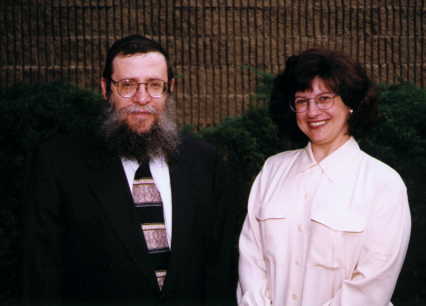
Rabbi Noson Gurary is the shliach who began the modern era of Chabad-Lubavitch in Buffalo. In 1971 (5731 / תשל״א), the Lubavitcher Rebbe, Rabbi Menachem Mendel Schneerson, sent him and his wife, Rebbetzin Tziviah Miriam Gurary, to the University at Buffalo. There they founded the Chabad House of Buffalo, one of the very first Chabad Houses on a college campus anywhere in the world.1
Over more than three decades, Rabbi Gurary taught accredited Judaic studies courses at the university and its law school. He and Rebbetzin Gurary founded Torah Temimah Day School, and he helped establish the Chabad Knesset Center on Starin Avenue. He brought more than ten families of shluchim to Buffalo and laid the groundwork for Chabad centers in Rochester, Syracuse, Ithaca and Binghamton. In the 2000s, he handed the campus work to his sons and later settled in Monsey, New York.2
His shlichus also continued a much older story. Chabad-Lubavitch life in Buffalo goes back to the 1880s, and the Frierdiker Rebbe sent shluchim to the city in the 1940s. When Rabbi Gurary once wrote to the Rebbe that he felt lonely on shlichus, the Rebbe answered that since he was doing “the work of the Rebbe, my father-in-law,” the Frierdiker Rebbe was with him — “and we are also together.” To read the full story of the rabbanim and shluchim who served Buffalo before and after him, see Chabad History in Buffalo.
Childhood in the Daled Amos of 770
Rabbi Noson Gurary was born in New York on Shushan Purim 5706 (1946). His father, Rabbi Zalman Gurary, was a prominent Chossid who was very close to the household of the Rebbeim. Rabbi Zalman Gurary attended the wedding of the Rebbe and Rebbetzin Chaya Mushka in 1928 and spoke about it for decades. Rabbi Noson has recalled that his grandfather was the Kopischnitzer Rebbe, and through his family he descends from great Chassidic masters, among them the Maggid of Mezritch and Rabbi Yisroel of Ruzhin. The Frierdiker Rebbe sent letters in honor of his birth and of his upsherenish.3
He spent much of his childhood in 770 Eastern Parkway. One of his earliest memories is the passing of the Frierdiker Rebbe on Yud Shevat 5710 (1950). As a small boy, he was once lifted through a window into a farbrengen so that he could say l’chaim to the Rebbe. Following the custom of his grandfather’s court, he reached out to shake the Rebbe’s hand. The Rebbe smiled broadly and shook it. Because his birthday falls on Shushan Purim, the Rebbe would often call on him to say l’chaim at the Purim farbrengen.
As his bar mitzvah approached, a question arose about which arm he should lay tefillin on: he writes with his left hand, but his right is the stronger. The Rebbe referred the question to the elder Chassidim. Through Reb Shmuel Levitin, the answer came that he should follow the view of the Tzemach Tzedek and lay tefillin on his left arm. Because the date was so close to Yud Shevat, the Rebbe also instructed him to begin putting on tefillin on Yud Shevat itself.4
Yeshiva, Semicha and Marriage
From the age of ten, he went into yechidus with the Rebbe every year for his birthday, and as a bochur he wrote to the Rebbe often. The answers covered his avodas Hashem, his learning, and even his daily schedule. One Lag BaOmer, the Rebbe answered a question of his by copying out a passage from the Zohar about simcha word for word. When he suffered chest pains as a young bochur, the Rebbe told him to see a doctor who would calm him down. Many years later, when the pains returned and another doctor found a real problem, the Rebbe reminded him of that answer. Rabbi Gurary has credited the Rebbe’s blessing for the fact that the problem came to nothing.5
Rabbi Gurary studied at the central Lubavitcher Yeshiva, Tomchei Temimim at 770 (the United Lubavitcher Yeshiva), where he received semicha. He is also ordained as a dayan, a rabbinical judge.6
In the late 1960s he married Miriam Hendel. Before the wedding, he asked the Rebbe in yechidus what teshuvah he should do. The Rebbe laughed and told him that, since simcha did not come naturally to him, the greatest teshuvah would be to be b’simcha. After the wedding, he continued learning in kollel for two years.7
1971: The Rebbe Sends Rabbi Gurary to Buffalo
After kollel, Rabbi and Mrs. Gurary wrote to the Rebbe that they were ready to go on shlichus wherever they were sent. The first proposal from Rabbi Chaim Mordechai Aizik Hodakov, the Rebbe’s chief secretary, was Finland. Rabbi Gurary agreed on the spot, though he knew nothing about the country, but the plan fell through. Greece was considered next, and that did not work out either.
Meanwhile, members of Buffalo’s Jewish community had written to the Rebbe’s secretariat. They were worried about the thousands of Jewish students at the University at Buffalo. The campus was in turmoil: there were violent protests against the Vietnam War, bombs went off at the university, and the hippie and drug culture was everywhere. Many Jewish students were being drawn to other religions. Buffalo was chosen for the Gurarys.
Before leaving, Rabbi and Mrs. Gurary went into yechidus with their eldest son, Avrohom. Rabbi Gurary had written two questions he expected to face on campus. On how to respond when students asked about the Vietnam War, the Rebbe told him to answer that the issues were too complex for him to give an opinion. On the difference between a Jew and a non-Jew, the Rebbe gave the example of building a house: it needs a builder, a plumber and a painter. The question is not who is better, but that each person fulfills his own role. Without that, the building can never be completed.8
In his first year on shlichus, the Rebbe blessed him in yechidus to make a dirah b’tachtonim, a dwelling place for Hashem, in Buffalo and in all the surrounding cities. The Rebbe concluded that the essential point of everything is to have Chassidishe nachas from one’s children. A year after the move, during the days of Selichos, the Rebbe had his secretariat give two machzorim to Rabbi and Mrs. Gurary.9
“What’s Your Jewish Name?”: Reaching a Campus in Upheaval
On his very first day on campus, Rabbi Gurary asked a hippie-looking student whether he was Jewish. The student was so offended by the question that he gathered a few friends, surrounded the rabbi, and said that only respect for his father kept him from punching him. Rabbi Gurary later admitted that he wondered whether campus work was for him. He reminded himself that this was his shlichus, and he soon found that it was a time of real searching. Students who heard what Judaism was truly about often embraced it.
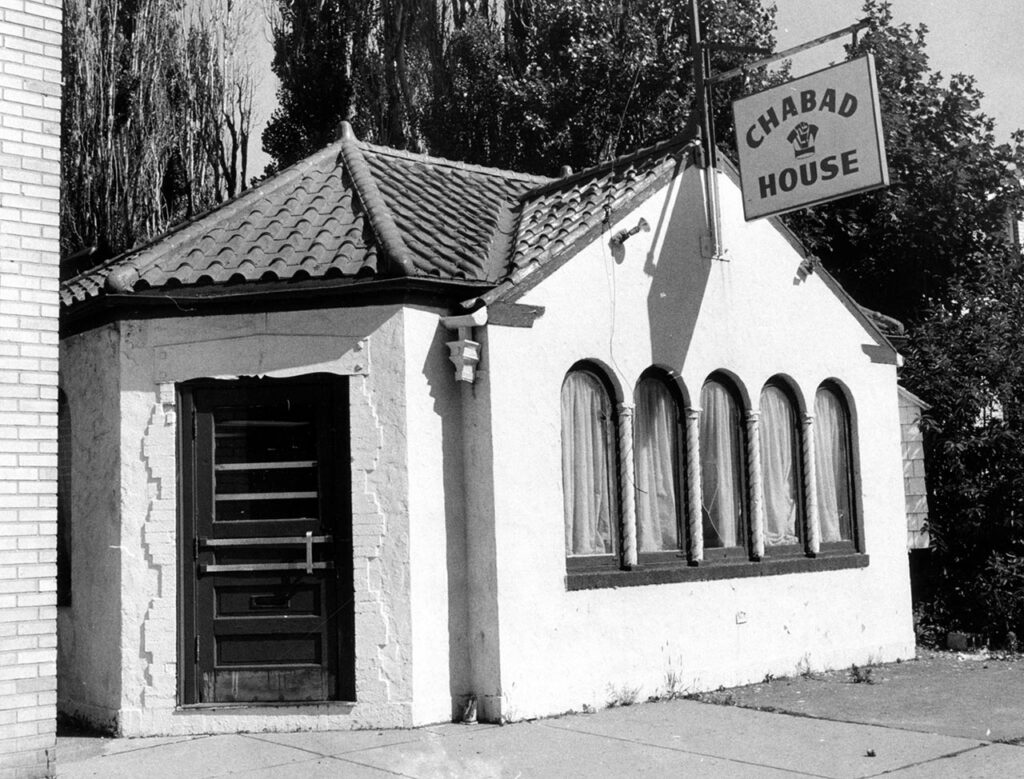
The Gurarys began running programs from their apartment on Amherst Manor Drive. They then opened the Chabad House of Buffalo at 3292 Main Street, a pagoda-style building that had once been a Chinese restaurant, near the university’s original Main Street campus.10
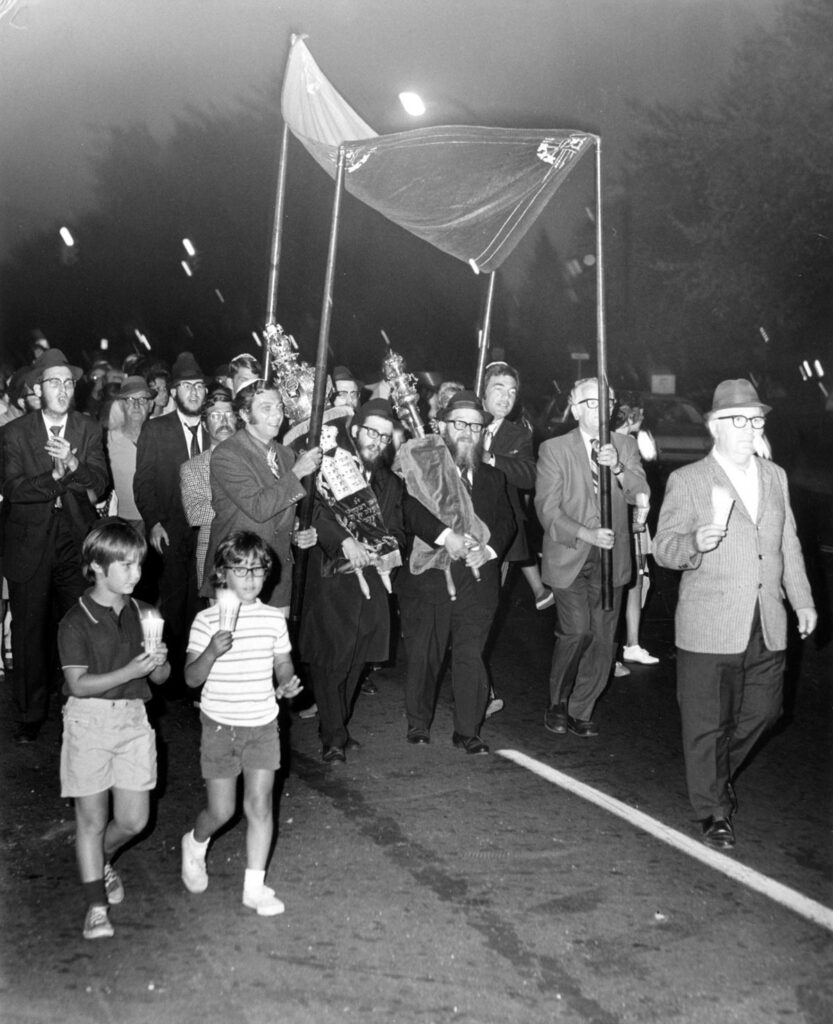
On September 7, 1971, about 500 people joined a candlelight march, complete with a Sefer Torah and a chuppah, to dedicate the new Chabad House. Speeches and the official dedication were followed by Jewish dancing and accordion music. UB’s student newspaper, The Spectrum, reported the plans: a minyan every morning at 8 a.m., tefillin available at all times, a kosher sandwich machine for students, weeknight study sessions on Jewish mysticism and the Torah, and a concert of Chassidic music with Eli Lipsker on September 15. Rabbi Gurary explained to the paper that, according to Chabad Chassidus, “through intellectual study and understanding of religious truth the individual is able to come closer to God in mind and heart.”11
Rabbi Gurary set up a table in the Student Union and made sure it could not be missed. A record player blasted Nichoach melodies beside a large picture of the Alter Rebbe and a shofar. His signs became famous: “POT for sale”, with “Put On Tefillin” in small letters underneath, and “LSD”, for “Let’s Start Davening.” Rather than asking students whether they were Jewish, he asked, “What’s your Jewish name?” From then on he called every student by their Hebrew name, however they dressed or whatever name they used.
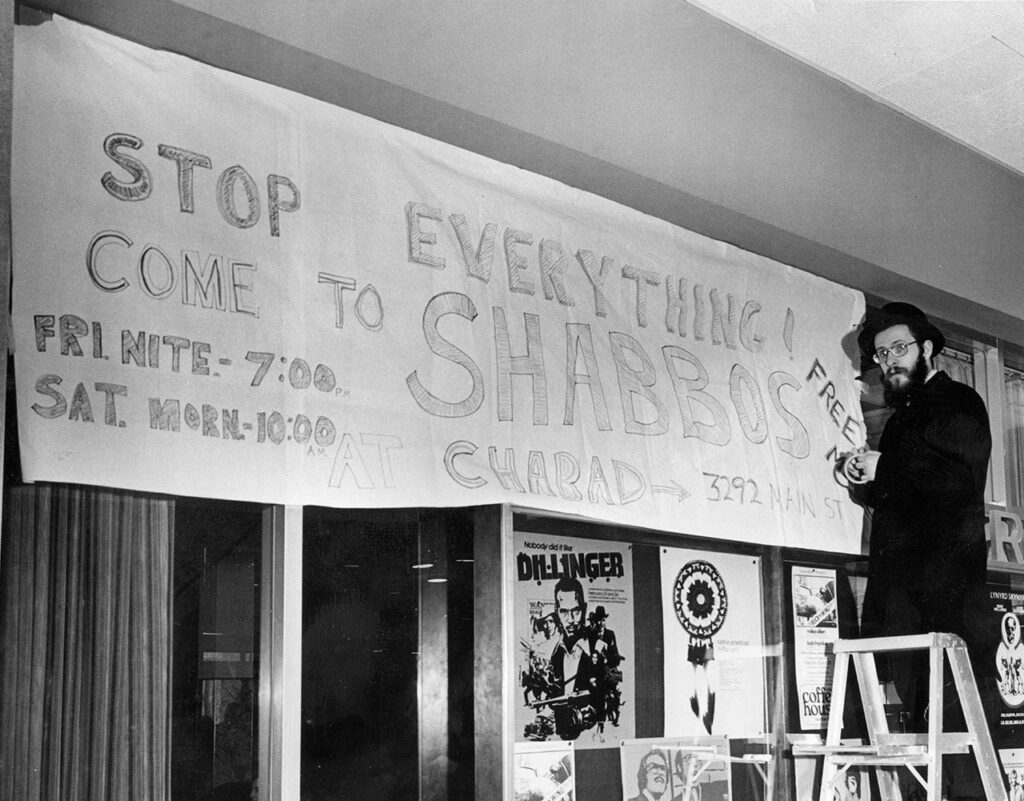
He knocked on doors in the dorms, visited the bars, and invited students to Shabbos meals, which he considered the most important activity of all. At services he davened at the amud as though hundreds were present, even when there was only one student. On Sukkos, a sukkah “the size of a shower stall,” towed by a tiny Toyota, brought the mitzvah of lulav and esrog across campus. As Rabbi Gurary put it, students were either for him or against him, but there was not a student who did not know about the Chabad House.12
On Simchas Torah, the Chabad House’s hakafos spilled into the street. One student recalled “parading around Main Street at midnight with the crowd led by Rabbi Nosson Gurary and Rabbi Heschel Greenberg.”13
The work was not without danger. One Friday night, as Rabbi Gurary stood outside the Chabad House talking with students, a car drove past and its passengers shouted “Heil Hitler!” Rabbi Gurary would not let the students leave on Shabbos, and the police arrested the attackers.14
The Rebbe guided him closely in these early years. When a corporation offered Chabad a large sum to lend its name to bingo events, Rabbi Gurary wrote to the Rebbe, who answered with an emphatic “No”. The Rebbe also told him to answer halachic questions himself rather than send people elsewhere. He was to be the rav; if he did not know an answer, he could telephone other rabbanim.15
He also brought students to experience Shabbos with the Rebbe through the Pegisha (“Encounter with Chabad”) programs in Crown Heights. At one Pegisha he promised that a generous benefactor would pay the way of any young woman who travelled straight from that Shabbos to the Beis Chana women’s institute in Minnesota. When many accepted and he had no idea how he would pay, he wrote to the Rebbe. The Rebbe covered the tickets, and continued to do so for several years.16
Some of his early students became Chassidim and shluchim themselves. Malka Werde (formerly Michele Braunstein) returned from India to take his Judaism course in the fall of 1971. Rabbi Gurary later introduced her to her husband, Yakov, and they married on the UB campus in 1975, in the first Chassidic wedding in Buffalo. Today she is a Chabad shlucha at FIT in Manhattan.17
Accredited Torah Courses at the University at Buffalo
Early in his shlichus, Rabbi Gurary received an instruction from the Rebbe through Rabbi Hodakov that at first seemed strange: do not teach on campus unless the class is credited. He submitted a résumé based on his semicha and his published articles, and the university accepted his rabbinic training as the equivalent of a master’s degree. In his very first semester he taught credited courses in Chassidic Philosophy, Jewish Mysticism, Jewish Law and Chassidic Music. The music course studied niggunim as literature, using the Nichoach records. That first fall, The Spectrum reported that he would also teach “the Sociological Study of Chassidism” through the university’s Bulletin Board Program.18
The courses grew into a program of many offerings across several departments. According to Rabbi Gurary, more than ten thousand students took them over the years. Students who enrolled had to attend week after week and were tested on the material, so they had to take the Torah they were learning seriously. He served for decades as an adjunct professor of Judaic studies and later also taught at the University at Buffalo Law School. The shluchim who worked under him taught credited courses as well.
He brought faculty, too, to meet the Rebbe. After an audience with the Rebbe, the renowned literary critic and UB English professor Leslie Fiedler emerged “red like a beet,” Rabbi Gurary recalled, and told him, “I just came down from Sinai.” The Rebbe had told him that there was a house on fire, and we must save as many people as possible.19
The Rebbe valued these courses highly and later told another shliach to learn from Rabbi Gurary how to get his own classes accredited. Years later, when Rabbi Gurary wrote that he was feeling down about his work, and at another time when fundraising had become so difficult that he considered stepping down, the Rebbe would not hear of it. He reminded him how many thousands of Jews had been brought closer to Torah and mitzvos through his courses.20
A Fire, a New Chabad House, and “One Bridge Too Far”
As the University at Buffalo moved to its new North Campus in Amherst, Chabad followed. It opened a center at 185 Maple Road in Amherst, but only weeks later, on Shabbos, a fire burned the building to the ground. Thank G‑d, everyone was saved. The Rebbe comforted the Gurarys with the saying of the Rebbeim that after a fire, one becomes rich.
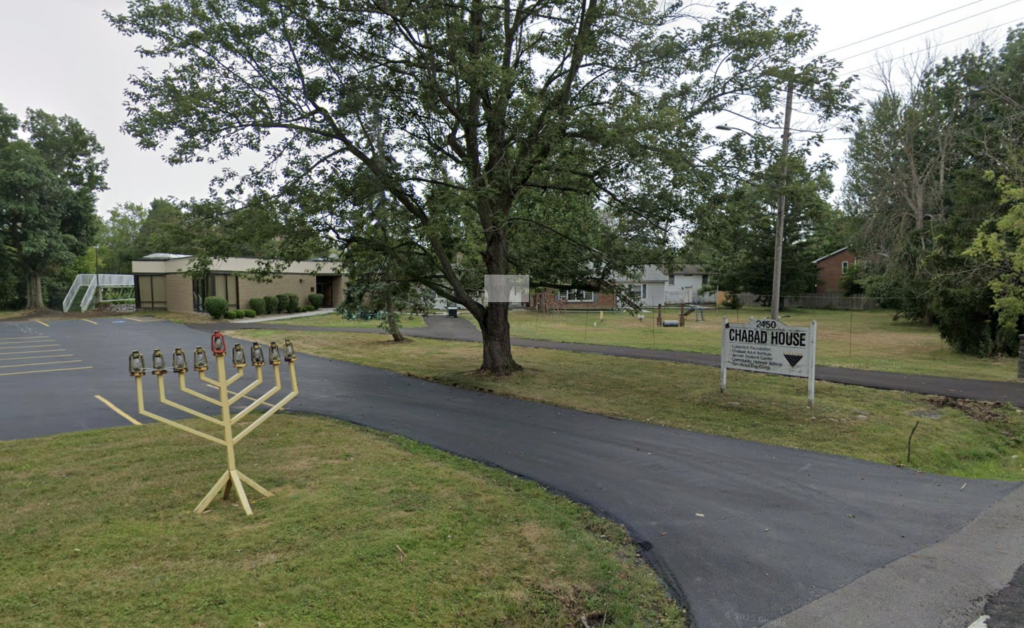
In November 1975, Chabad purchased a much larger property at 2450 North Forest Road in Getzville, beside the new campus, and the new Chabad House opened in 1976. There was one problem: Ellicott Creek ran between the university and the Chabad House, and there was no bridge.
Just before Rosh Hashanah, a Jewish engineer built a floating pontoon bridge of wood on drums so that students could walk across. Before Yom Kippur, a man paddling down the creek found his way blocked and complained to every authority he could find. The story went citywide, and the newspapers ran the headline “Chabad Went One Bridge Too Far.” The university raised its own objections: a bridge from a state university to a religious institution, blocking a public waterway.
Rabbi Gurary’s response was to order a bigger, permanent steel bridge, high enough for boats to pass beneath, and to obtain the necessary permits. For months the bills and interest mounted while he stayed in constant touch with the Rebbe. In the end the bridge was paid for with public funds rather than by Chabad. The Speaker of the New York State Assembly lobbied in Albany for the state to fund it. The university paved the path and put up an official sign directing students to the Chabad House. Rabbi Gurary has called it a miracle that only the Rebbe’s blessings could achieve. The Ellicott Creek footbridge still links the Chabad House to the campus, opposite the Wilkeson and Spaulding dormitories.21
Torah Temimah Day School and Camp Gan Israel
The Gurarys’ work soon reached beyond the campus to Buffalo’s Jewish children. In 5736 (1975–1976), the year the Rebbe launched Mivtza Chinuch, they founded Torah Temimah Day School. It began in their own home and gave children a full Torah education — Chumash, Hebrew reading, davening and Jewish tradition — alongside English, math and general studies. Rebbetzin Miriam Gurary served as principal and insisted that both the Hebrew and English departments keep the highest standards.
Many of the first students came from homes that were not yet observant. The school survived on sacrifice and constant fundraising, much of it carried personally by the Gurarys. In 1976, Shaina Ebert, later Rebbetzin Shaina Charitonow, joined as a teacher. On Rosh Chodesh Iyar 5742 (1982), the school received a letter of encouragement from the Rebbe.
Torah Temimah later moved to several locations. In 2008, it merged with Jewish Heritage Day School to form Ohr Temimim Day School, now on Audubon Parkway. In the summer, Camp Gan Israel at the Getzville Chabad House gave generations of Buffalo children a Jewish camp experience.22
Building a Chabad Community in Buffalo
Between 1972 and 1986, Rabbi Gurary brought approximately ten shluchim and their families to Buffalo. They included Rabbi Heschel and Lea Greenberg (1972), Rabbi Dovid Sholom and Shulamit Pape, Rabbi Shmuel Yosef and Ester Zirkind, Rabbi Gershon and Sarah Leah Oberlander, and Rabbi Shmaryahu and Shaina Charitonow (1986). Several went on to lead Chabad institutions of their own, in Buffalo and around the world.
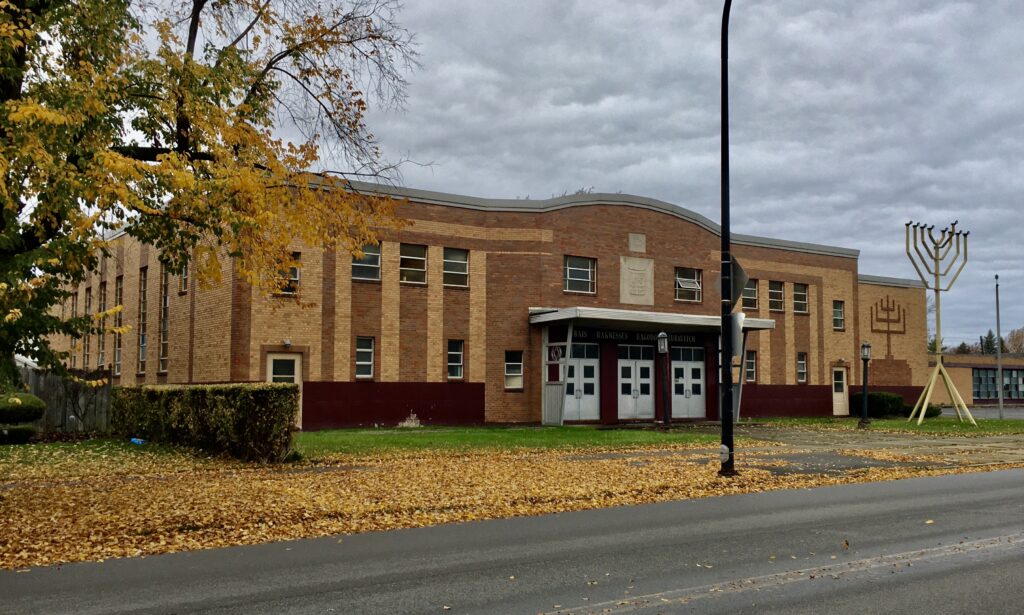
On July 12, 1984, Chabad purchased the synagogue building of Temple Beth David–Ner Israel at 500 Starin Avenue in North Buffalo. It became Bais HaKnesset HaGadol–Lubavitch, known as the Chabad Knesset Center, with daily minyanim, Shabbos and Yom Tov services, shiurim and farbrengens. Rabbi Shmaryahu Charitonow leads it today.23
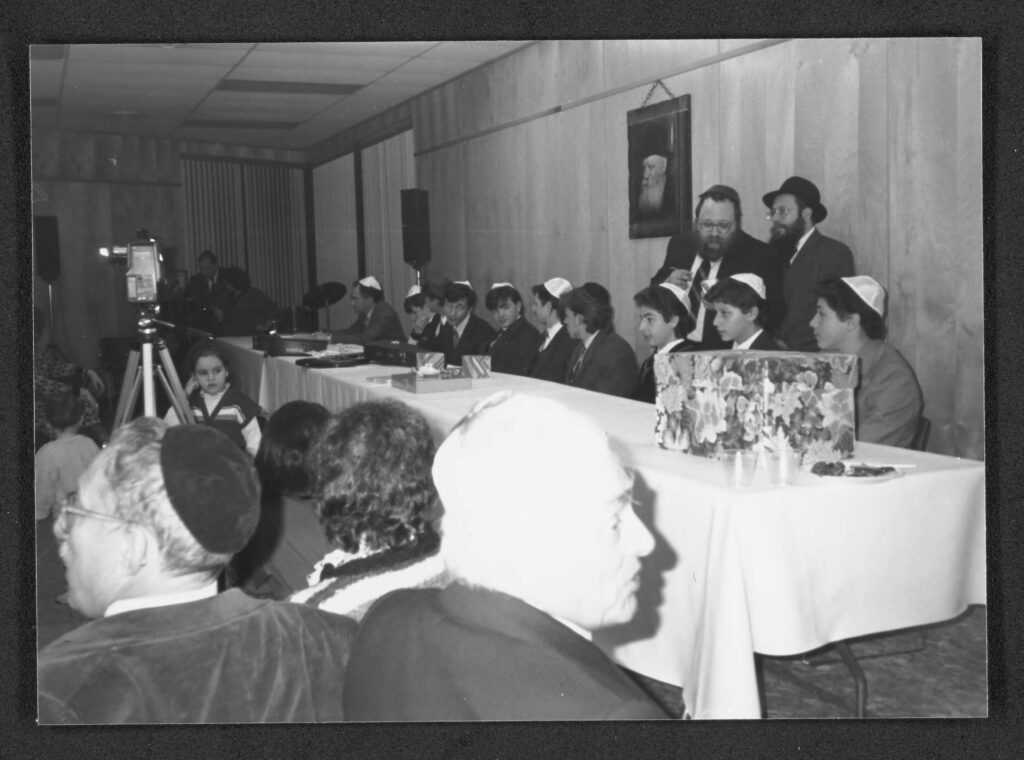
Chabad’s work in these years also reached the families of former Soviet Jews who settled in Buffalo. In 1990, Chabad helped the local community of former Soviet Jews celebrate a community bar mitzvah, with Rabbi Gurary and Rabbi Heschel Greenberg both taking part.24
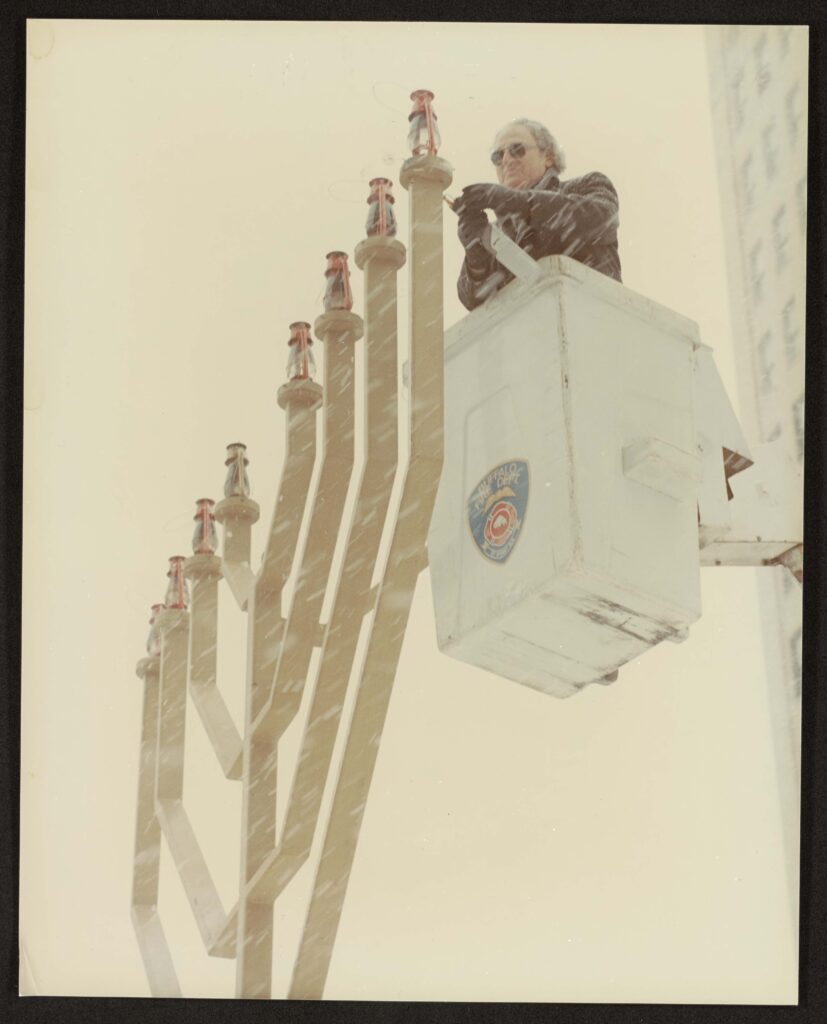
Chabad also brought the Chanukah menorah to the heart of downtown Buffalo. Around 1990, Nobel laureate Professor Herbert Hauptman, winner of the 1985 Nobel Prize in Chemistry, lit Chabad’s giant public menorah in Lafayette Square.25
Rabbi Gurary also carried the Rebbe’s campaign for the Seven Noahide Laws to Washington. On September 17, 1987, the bicentennial of the U.S. Constitution, Congressman Jack Kemp of Buffalo entered remarks into the Congressional Record that began: “Rabbi Noson Gurary of the Chabad Lubavitch House of Western New York reminds me that there is a system of ancient laws, the Noahide laws, which correspond to the tenets set forth in the preamble of our Constitution.”26
The Rebbe’s Encouragement: “We Are Also Together”
About ten years into the shlichus, the university completed its move to the sprawling suburban campus, and students became harder to gather. For more than twenty years, Rabbi Gurary spent Shabbos mornings going door to door through the dorms to make a minyan. Having grown up spending Yom Tov among thousands of Chassidim in 770, he found the Yomim Tovim on campus especially lonely.
When he wrote this to the Rebbe, the Rebbe replied:
״וויבאלד אז דו טוסט די ארבעט פון דעם רבי׳ן דעם שווער, איז ער מיט דיר״
“Since you are doing the work of the Rebbe, my father-in-law, he is with you.”״און מיר זיינען אויכעט צוזאמען״
“And we are also together.”
Rabbi Gurary has said that hearing from the Rebbe that he was with him and understood what he was going through gave him tremendous strength to continue. The Rebbe’s words also tied his work to an earlier chapter of Buffalo’s history. In 1943, the Frierdiker Rebbe had promised Rabbi Hershel Fogelman, before he left for Buffalo: “You are not alone. Wherever you work for the strengthening of Torah, I am with you.”27
Rabbi Gurary has also often recalled a farbrengen on Shabbos Parshas Noach 5728 (1967). There the Rebbe addressed a shliach who had left a difficult post: he was like Noach, saved in the teivah while the world was in a flood. If shlichus brings difficulties, the Rebbe said, “Du host a kopveitik? Nem an aspirin!” — “You have a headache? Take an aspirin!” — and carry on with the work. Rabbi Gurary has called this a lesson that remains vital for shluchim today.28
Scholar, Author and Jewish Law
Alongside his shlichus, Rabbi Gurary published three books in English on Chassidic thought:
- The Thirteen Principles of Faith: A Chasidic Viewpoint (Jason Aronson, 1996; later republished by the Menachem Education Foundation)
- Chasidism: Its Development, Theology, and Practice (Jason Aronson, 1997)
- The Jewish Holy Days in Chasidic Philosophy (Jason Aronson, 2000)
He later earned a Ph.D. in philosophy from Moscow State University, completed by long distance. His biography also lists him as founder of the Center for World Culture and Chassidism at Moscow State University, the International Institute of Chassidic Studies, and the Women’s Institute for Jewish Traditions in Buffalo.29
His teaching at the law school led to an unusual relationship with the United States Supreme Court. At his invitation, Justice Antonin Scalia came to Buffalo on March 13, 2002, as the featured speaker at a luncheon at the Hyatt Regency co-sponsored by the Chabad House of Buffalo and the UB Law School. The audience numbered about a thousand lawyers.30
Rabbi Gurary also served as director of the National Institute for Judaic Law, formed by Jewish lawyers and legal scholars to promote the understanding of Jewish law. Its launch in November 2002 was marked by a dinner for about 200 guests at the Supreme Court, the first kosher dinner ever served there. Justices Scalia, Ginsburg and Breyer all attended and spoke. Rabbi Gurary explained that nearly every legal question “in some way, with a tremendous amount of logic, has foundation in Jewish law.”31
The Next Generation and Leaving Buffalo
Rabbi and Rebbetzin Gurary raised seven children in Buffalo. In the 1990s, their children joined the shlichus. Rabbi Avrohom and Chani Gurary came in 1994, followed by Rabbi Moshe and Rivka Gurary in 1999. As they took on more of the campus work, Rabbi Gurary stepped back from its day-to-day leadership. His sons and their wives carry on Chabad’s work at the University at Buffalo today.32
Rebbetzin Tziviah Miriam Gurary, his partner in every part of the Buffalo shlichus, passed away on 12 Iyar 5766 (May 10, 2006), at the age of 55, after an illness. Alumni remember her as a mentor who taught many of them the basics of Jewish life and guided young women through dating, marriage and careers. One recalled that she was “always smiling, like she was about to laugh.”33
In the 2000s, after more than three decades in Buffalo, Rabbi Gurary left the city and settled in Monsey, New York. There he serves as a mashpia, teaching Chassidus and leading farbrengens in Monsey and Crown Heights. He still keeps in touch with many former students, and alumni around the world join his weekly online class. In November 2021, he led a series of Yud-Tes Kislev farbrengens in England, in Manchester, Gateshead, Golders Green and Stamford Hill.34
His Lasting Legacy in Buffalo
What began in 1971 at a Student Union table grew into a network of institutions serving Buffalo’s university students, children and families. Its influence reaches far beyond Western New York. Among the students Rabbi Gurary reached were Rabbi Mordechai “Big Mo” Siev, who studied in Buffalo from 1976 to 1979 and became outreach director at Ascent in Tzfas, and Susan (Shaina Sara) Handelman, who became professor of English literature at Bar-Ilan University. Another, Howard (Chaim) Mischel, raised a family in Israel in which both sons and both sons-in-law became rabbis. Hundreds of other families trace their return to Torah and mitzvos to his courses and to the Gurarys’ Shabbos table.
In August 2021, about 400 alumni, supporters and their families gathered online to celebrate fifty years of Chabad at the University at Buffalo. Many in Israel joined at four in the morning. At that reunion, the alumni decided to begin the weekly class with Rabbi Gurary that continues to this day.35
Rabbi Noson and Rebbetzin Miriam Gurary’s shlichus is a central chapter in the story of Chabad in Buffalo. That story began with Anshe Lubavitz in the 1880s, continued through the rabbanim and shluchim of the Frierdiker Rebbe, and goes on today in the work of the shluchim who followed them. Read the full history at Chabad History in Buffalo.
Sources, Footnotes & Links
- A Chassidisher Derher, Shevat 5785; Lubavitch.com; Chabad.org.
All three describe the Chabad House of Buffalo as one of the first campus Chabad Houses. Derher dates the move to Buffalo to 5731.
A Chassidisher Derher — “Pinpoints: Buffalo, NY,” Shevat 5785 (PDF)
Lubavitch.com — “A Bridge Built in Buffalo”
Chabad.org — “Legendary Buffalo Campus Rabbi’s 50 Years on the Job” ↩︎ - Chabad Buffalo, “Chabad History in Buffalo.”
The Buffalo history records that between 1972 and 1986 he brought approximately ten shluchim to the city.
Chabad Buffalo — Chabad History in Buffalo ↩︎ - A Chassidisher Derher, Cheshvan 5778, pp. 36–37; Anash.org; author biography; COLlive.
In the Derher interview Rabbi Gurary gives his birth year as 5706 and his birthday as Shushan Purim, and identifies his father and grandfather. The Anash.org piece records Rabbi Zalman Gurary’s memories of the Rebbe’s wedding. His book jacket lists his descent from the Maggid of Mezritch and Rabbi Yisroel of Ruzhin, and COLlive (2021) notes that he and the Sadigur Rebbe of London are both descendants of the Ruzhiner Rebbe.
A Chassidisher Derher — “Pioneer on Campus: Interview with Rabbi Nosson Gurary,” Cheshvan 5778 (PDF)
Anash.org — “My Father’s Memories of the Rebbe’s Wedding”
Author biography, The Jewish Holy Days in Chasidic Philosophy (Jason Aronson, 2000)
COLlive — “Buffalo Shliach to Address Series of UK Events,” November 2021 ↩︎ - A Chassidisher Derher, Cheshvan 5778, pp. 37–38.
Rabbi Gurary’s first-hand account of his childhood interactions with the Rebbe, his bar mitzvah, and the instructions he received about tefillin.
A Chassidisher Derher — “Pioneer on Campus: Interview with Rabbi Nosson Gurary,” Cheshvan 5778 (PDF) ↩︎ - A Chassidisher Derher, Cheshvan 5778, pp. 37–39; JEM, Living Torah, Program 749.
The Living Torah episode “A Real Connection” presents Rabbi Gurary’s account of the Rebbe’s advice regarding his chest pains.
A Chassidisher Derher — “Pioneer on Campus: Interview with Rabbi Nosson Gurary,” Cheshvan 5778 (PDF)
JEM Living Torah, Program 749 — “A Real Connection” ↩︎ - Author biography, The Jewish Holy Days in Chasidic Philosophy.
“Noson Gurary is an ordained rabbi and Jewish judge. He received his rabbinical ordination at the United Lubavitcher Yeshiva in Brooklyn, New York.”
Author biography, The Jewish Holy Days in Chasidic Philosophy (Jason Aronson, 2000) ↩︎ - A Chassidisher Derher, Cheshvan 5778, p. 41; Chabad.org.
Derher records the Rebbe’s answer before his wedding and his years in kollel. Chabad.org reports that in 1971 he had been married for two years.
A Chassidisher Derher — “Pioneer on Campus: Interview with Rabbi Nosson Gurary,” Cheshvan 5778 (PDF)
Chabad.org — “Legendary Buffalo Campus Rabbi’s 50 Years on the Job” ↩︎ - A Chassidisher Derher, Cheshvan 5778, pp. 41–42; Chabad.org; JEM Here’s My Story.
Rabbi Gurary’s own accounts of the proposals of Finland and Greece, the request from Buffalo, and the yechidus before his departure. Chabad.org adds that Denver and Houston were also briefly considered.
A Chassidisher Derher — “Pioneer on Campus: Interview with Rabbi Nosson Gurary,” Cheshvan 5778 (PDF)
Chabad.org — “Legendary Buffalo Campus Rabbi’s 50 Years on the Job”
JEM Here’s My Story — “Riots, Bombings, and Chasidic Music” (via CrownHeights.info) ↩︎ - A Chassidisher Derher, Cheshvan 5778, p. 43.
From the sidebar “The Essential Point.”
A Chassidisher Derher — “Pioneer on Campus: Interview with Rabbi Nosson Gurary,” Cheshvan 5778 (PDF) ↩︎ - Jewish Buffalo History Center; Lubavitch.com; Chabad.org.
The Jewish Buffalo History Center records the apartment on Amherst Manor Drive and the Main Street address. Lubavitch.com describes the building as a former Chinese restaurant.
Jewish Buffalo History Center — Chabad House of Buffalo
Lubavitch.com — “A Bridge Built in Buffalo”
Chabad.org — “Legendary Buffalo Campus Rabbi’s 50 Years on the Job” ↩︎ - The Spectrum, September 13, 1971; University at Buffalo Archives, Golden Reunion 1971–72.
UB Archives: “On September 7, 1971 over 500 people attended the dedication of Chabad House at 3292 Main Street.”
The Spectrum (University at Buffalo), September 13, 1971, p. 7 — “Chabad House dedicated in candlelight ceremony”
University at Buffalo Archives — Golden Reunion, 1971–72 ↩︎ - A Chassidisher Derher, Cheshvan 5778, pp. 42–43; Lubavitch.com; COLlive.
Rabbi Gurary’s descriptions of his first encounter on campus, his Student Union table, and his outreach methods. Lubavitch.com recounts the sukkah mobile through the memories of alumnus Howard (Chaim) Mischel, UB ’72.
A Chassidisher Derher — “Pioneer on Campus: Interview with Rabbi Nosson Gurary,” Cheshvan 5778 (PDF)
Lubavitch.com — “A Bridge Built in Buffalo”
COLlive — “A Shliach’s Vision Broke Barriers and Inspired Generations on Campus” ↩︎ - Beis Moshiach Magazine #1345, p. 42.
Beis Moshiach Magazine #1345 (Shevat 5783), interview with Tamar Adelstein, p. 42 (PDF) ↩︎ - Chabad.org, “Legendary Buffalo Campus Rabbi’s 50 Years on the Job.”
As recalled by Rabbi Mordechai “Big Moe” Siev, a student at UB from 1976 to 1979.
Chabad.org — “Legendary Buffalo Campus Rabbi’s 50 Years on the Job” ↩︎ - A Chassidisher Derher, Cheshvan 5778, p. 43.
From the section “Horaos/Credited Courses.”
A Chassidisher Derher — “Pioneer on Campus: Interview with Rabbi Nosson Gurary,” Cheshvan 5778 (PDF) ↩︎ - A Chassidisher Derher, Cheshvan 5778, pp. 44–45.
From the section of the interview describing the Pegisha and Beis Chana.
A Chassidisher Derher — “Pioneer on Campus: Interview with Rabbi Nosson Gurary,” Cheshvan 5778 (PDF) ↩︎ - Lubavitch.com, “A Bridge Built in Buffalo.”
Alumni recollections collected for the fiftieth anniversary of Chabad at UB.
Lubavitch.com — “A Bridge Built in Buffalo” ↩︎ - The Spectrum, September 13, 1971; JEM Here’s My Story.
The Spectrum (University at Buffalo), September 13, 1971, p. 7 — “Chabad House dedicated in candlelight ceremony”
JEM Here’s My Story — “Riots, Bombings, and Chasidic Music” (via CrownHeights.info) ↩︎ - Chabad.org, “Legendary Buffalo Campus Rabbi’s 50 Years on the Job.”
Chabad.org — “Legendary Buffalo Campus Rabbi’s 50 Years on the Job” ↩︎ - A Chassidisher Derher, Cheshvan 5778, pp. 43–44; JEM Here’s My Story; Chabad.org; Lubavitch.com; JLI.
JEM gives the four subjects of his first semester and the figure of more than ten thousand students. Derher gives three courses in the first semester. Chabad.org reports the Rebbe’s refusal to accept his resignation, and the JLI biography dates his teaching at SUNY Buffalo from 1970 to 2008.
A Chassidisher Derher — “Pioneer on Campus: Interview with Rabbi Nosson Gurary,” Cheshvan 5778 (PDF)
JEM Here’s My Story — “Riots, Bombings, and Chasidic Music” (via CrownHeights.info)
Chabad.org — “Legendary Buffalo Campus Rabbi’s 50 Years on the Job”
Lubavitch.com — “A Bridge Built in Buffalo”
JLI — Author biography of Rabbi Dr. Noson Gurary ↩︎ - Chabad Buffalo, “Chabad History in Buffalo”; A Chassidisher Derher, Cheshvan 5778, p. 44; Lubavitch.com; Jewish Buffalo History Center; COLlive.
Rabbi Gurary recalled the university paying for the permanent bridge and posting a sign reading “Chabad House University Bridge.” Lubavitch.com describes the Assembly Speaker’s lobbying and the state funding. The Jewish Buffalo History Center lists the Getzville Chabad House from 1976 and notes its location by the Ellicott Creek footbridge.
Chabad Buffalo — Chabad History in Buffalo
A Chassidisher Derher — “Pioneer on Campus: Interview with Rabbi Nosson Gurary,” Cheshvan 5778 (PDF)
Lubavitch.com — “A Bridge Built in Buffalo”
Jewish Buffalo History Center — Chabad House of Buffalo
COLlive — “A Shliach’s Vision Broke Barriers and Inspired Generations on Campus” ↩︎ - Anash.org, “The Miraculous School”; Jewish Buffalo History Center; Chabad Buffalo, “Chabad History in Buffalo.”
Anash.org (2026) marks fifty years of the school and the twentieth yahrzeit of Rebbetzin Gurary. The Jewish Buffalo History Center records that the school began in the Gurarys’ home and later merged into Ohr Temimim.
Anash.org — “The Miraculous School: 50 Years of Torah Tmimah of Buffalo”
Jewish Buffalo History Center — Chabad House of Buffalo
Jewish Buffalo History Center — Ohr Temimim
Chabad Buffalo — Chabad History in Buffalo ↩︎ - Chabad Buffalo, “Chabad History in Buffalo.”
See the sections on the shluchim of the 1970s and 1980s and on Bais HaKnesset HaGadol–Lubavitch.
Chabad Buffalo — Chabad History in Buffalo ↩︎ - University at Buffalo Libraries, Digital Collections, item JBIC556.
Photograph from the Jewish Federation of Greater Buffalo Records, University Archives, Jewish Buffalo Archives Project. Reproduced with permission.
University at Buffalo Libraries, Digital Collections — “Local Former Soviet Jews, celebrate a community Bar mitzvah with help of Chabad,” 1990 (JBIC556) ↩︎ - University at Buffalo Libraries, Digital Collections.
Photograph by Frederic Marschall, from the Chabad House of Buffalo collection, University Archives, Jewish Buffalo Archives Project; the archive dates it “1990?”. Reproduced with permission.
University at Buffalo Libraries, Digital Collections — “Professor Herbert Hauptmann lights the Chanukah Menorah in Lafayette Square, 1990?” ↩︎ - Congressional Record, September 17, 1987.
Rep. Kemp dated his remarks “23 Elul 5747 on the Hebrew calendar” and added that “Rabbi Gurary points out that conforming to the standards set forth in the Noahide laws can help our citizens achieve the goals set forth in our preamble.”
Congressional Record, Vol. 133, September 17, 1987 — Hon. Jack F. Kemp, “The Noahide Laws and the Constitution Preamble” ↩︎ - A Chassidisher Derher, Cheshvan 5778, p. 45; JEM Here’s My Story; Chabad Buffalo, “Chabad History in Buffalo.”
The Yiddish wording follows the Chabad History in Buffalo page, which also discusses the parallel with the Frierdiker Rebbe’s words to Rabbi Fogelman.
A Chassidisher Derher — “Pioneer on Campus: Interview with Rabbi Nosson Gurary,” Cheshvan 5778 (PDF)
JEM Here’s My Story — “Riots, Bombings, and Chasidic Music” (via CrownHeights.info)
Chabad Buffalo — Chabad History in Buffalo ↩︎ - A Chassidisher Derher, Cheshvan 5778, pp. 40–41.
The sicha was later published in Likkutei Sichos, vol. 5, p. 47; Rabbi Gurary notes that the spoken version was considerably more pointed.
A Chassidisher Derher — “Pioneer on Campus: Interview with Rabbi Nosson Gurary,” Cheshvan 5778 (PDF) ↩︎ - Library catalog records; author biography; JLI author biography; Chabad.org.
Publication details are taken from library and catalog records. His book jacket gives his doctorate in Jewish philosophy from Moscow Lomonosov University. The institutes are listed in his JLI biography.
National Library of Israel — The Thirteen Principles of Faith: A Chasidic Viewpoint
Book listing — Chasidism: Its Development, Theology, and Practice
University of Notre Dame Library — The Jewish Holy Days in Chasidic Philosophy
Author biography, The Jewish Holy Days in Chasidic Philosophy (Jason Aronson, 2000)
JLI — Author biography of Rabbi Dr. Noson Gurary
Chabad.org — “Legendary Buffalo Campus Rabbi’s 50 Years on the Job” ↩︎ - University at Buffalo News Release, February 4, 2002; UBNow; Chabad.org.
Chabad.org adds that Justice Scalia introduced Rabbi Gurary to Justices Stephen Breyer and Ruth Bader Ginsburg.
University at Buffalo News Release — “The Honorable Antonin Scalia to Speak at Luncheon,” February 4, 2002
UBNow — Recollections of Justice Scalia’s 2002 Buffalo visit
Chabad.org — “Legendary Buffalo Campus Rabbi’s 50 Years on the Job” ↩︎ - JTA, “Lawyers look to Talmud and Torah,” November 24, 2002; COLlive.
JTA — “Lawyers look to Talmud and Torah,” November 24, 2002
COLlive — “A Shliach’s Vision Broke Barriers and Inspired Generations on Campus” ↩︎ - Lubavitch.com; Chabad.org; Jewish Buffalo History Center; author biography.
Lubavitch.com — “A Bridge Built in Buffalo”
Chabad.org — “Legendary Buffalo Campus Rabbi’s 50 Years on the Job”
Jewish Buffalo History Center — Chabad House of Buffalo
Author biography, The Jewish Holy Days in Chasidic Philosophy (Jason Aronson, 2000) ↩︎ - Lubavitch.com; Anash.org, “The Miraculous School.”
Lubavitch.com gives her passing in 2006 at the age of 55. Anash.org marked her twentieth yahrzeit on 12 Iyar 5786.
Lubavitch.com — “A Bridge Built in Buffalo”
Anash.org — “The Miraculous School: 50 Years of Torah Tmimah of Buffalo” ↩︎ - Lubavitch.com; Anash.org, “North Crown Heights Inspired by Rabbi Nosson Gurary”; Chabad.org.
Lubavitch.com reports his move to Monsey. Anash.org (December 2025) describes him as a mashpia in Monsey and reports his Yud-Tes Kislev farbrengen in North Crown Heights.
Lubavitch.com — “A Bridge Built in Buffalo”
Anash.org — “North Crown Heights Inspired by Rabbi Nosson Gurary”
Chabad.org — “Legendary Buffalo Campus Rabbi’s 50 Years on the Job”
COLlive — “Buffalo Shliach to Address Series of UK Events,” November 2021 ↩︎ - Lubavitch.com; Chabad.org.
Alumni recollections and the fiftieth-anniversary reunion.
Lubavitch.com — “A Bridge Built in Buffalo”
Chabad.org — “Legendary Buffalo Campus Rabbi’s 50 Years on the Job” ↩︎